Friday, March 21, 2014

Part Time Cooks: Hip-Hop Performance in Seoul 3/28/2014


I'd just like to put up a little add for a friend of mine here in Seoul. My friend Blessing, who goes by the name Black Moss has formed a new group called Part Time Cooks. Their style is somewhere between hip hop and jazz. I've heard a few of their songs and I think they should definitely be worth checking out.

Here's the info for their upcoming show:


Here are some samples of some of the group members' music. They've all got pretty nice sound to them.


If I've piqued your interest, see the map below for directions to the show:


Wednesday, March 19, 2014

Tibetan Food

Even though I was in India, I spent the majority of my time in the Tibetan community, as I was working at a Tibetan Buddhist temple. That means I got a lot of exposure to Tibetan food. What I discovered after 5 weeks in the Tibetan community is that there really aren't that many foods on a Tibetan menu (especially when comparing it to the never-ending menus at the Indian restaurants around the corner). I tried my best to document all the food I ate here, but there are a few important dishes missing. I'll introduce them later.


This dish is called Shapale. Sha is meat and Pale is bread, so basically 'meat bread'. Actually, it's like a giant fried meat filled dumpling. This was served with fried potatoes and chili powder. I heard that in Tibet, chili pepper powder is not popular, but here in India no Tibetan restaurant would be complete without several kinds of chili paste/powder.


Here is the monastery's version of thukpa. This was was lacking a lot of broth, though, it was mostly just noodles.


This is more like a normal thukpa. Long noodles with vegetables and this particular one has meat, too. The meat is 'mutton'. Now, I've always learned that mutton was sheep meat, particularly older sheep as opposed to lamb, which would be a young sheep. However, I realized (almost at the end of my stay) that generally when you order 'sha' (meat) in Tibetan restaurants, it is what they called 'mutton' however, 'mutton' in India is not sheep meat as I originally believed, but in fact is goat meat. So, I ate a lot of goat during my stay in India... and not necessarily on purpose...


Here are some momos, sha momos I believe. There were three kinds of momos I saw a lot in Tibetan restaurants. Meat (mutton goat) momos, spinach and cheese momos, and potato momos. Though, the potato momos were my favorite, though they were spiced with some kind of Indian style spices, so I don't know how authentic Tibetan they were.


This dish is called Then Thuk. Then (pronounced ten) means 'pull' and Thuk (pronounced tuk) is noodle, so this dish can be called pulled noodles. They're called this because to make them, you can make a long string of dough and pull off small flat rectangles to make these noodles. As you can see, the noodles are flat, short and wide, like little squares/rectangles. I just found this recipe online while researching this dish... it seems pretty simple to make... perhaps I'll try it some day...


This one was kind of special. This is called lapping (sounds like laughing), and is a typical street food. The noodles are served cold with a spicy sauce. I'm not sure why this particular one was so yellow, as when I search online, it seems the noodles are usually clear. It was quite fun to watch this being made as the woman had a sheet of this gelatinous substance. She then rolled it up and cut it to make many noodles. Then she just threw a little bit of all the spices on her table together to make the spicy sauce.


But, somehow I forgot to photograph one of my favorite Tibetan dishes, Chow Mein, dispite eating it on many occasions. Now, I know what you're thinking... chow mein, that's Chinese food. Well, yes, that may be true, but clearly, thanks to geography if for no other reason, it's not hard to see why Tibetan food might be similar to Chinese food. I find Tibetan Chow Mein to be much less salty and oily than its Chinese counterpart. I'm not sure how the cooking methods are different, but Tibetan chow mein is definitely worth a try.

Another food missing here is tingmo, which is steamed bread, a little bit like Chinese style steamed bread. I never took a photo of it because I guess it was just too normal to me. At the monastery, breakfast everyday was tingmo. I found it to be a little dry and bland until I discovered that when they are fried and eaten with ketchup on the side they become absolutely scrumptious.

Butter tea is another famous part of Tibetan cuisine. However, thanks to bad memories of the butter tea in Meili Xueshan several months before going to India, I couldn't bring myself to drink it on this trip...


Finally, I'll leave you with a photo of one of the restaurants in the Chauntra Tibetan colony which we often frequented. They were always open (there was a bed in the restaurant, I'm pretty sure the owners live in the restaurant) and the woman there spoke quite passable English and was very friendly. Later we found that the shop two doors down, though, had the most fantastic potato momos we'd ever tried. In any case, it's good to have options.

Tuesday, March 11, 2014

Baijnath, Palampor, and a toy train

 Indian buses look just like how you would expect them to look... 

 With only one day per week off from working in the monastery, we looked forward to our Fridays off a lot. Unfortunately, our day in Tso Pema was the last bright sunny day we had on our days off. The next Friday it poured and we did nothing but lay around the monastery and sleep. And the following Friday, after a week of beautiful weather, we woke up to thunderstorms again. But, as my days in India were quickly flying by, I couldn't let my last Friday off from work be ruined by another rain storm. So this time, my Tibetan co-worker, my new American co-worker put on our raincoats and our umbrellas and trudged out into the rain to catch a bus to the nearby town of Baijnath.

The good thing about traveling by bus is that you can go between towns for almost nothing. I think we paid about 20 rupees or so for this bus ride, which is about $0.33. Though, the downside is that the buses are crowded and take more than double the time of driving.


 In Baijnath, there's really only one thing to see, and that is the town's namesake, the Baijnath temple. This is a temple dedicated to Shiva and it is ancient. The temple was constructed in 1204AD and apparently there was even a temple on these grounds before this one was constructed. So, basically folks have been praying here for a really long time.


As uncomfortable as I sometimes feel in temples which are not my own religion, I must say, being in Hindu temples was one of the most uncomfortable experiences for me. I know in a church I should cross myself or kneel in a pew, and I know in a Buddhist temple I should bow a few times, but in a Hindu temple I really have no idea what I should/ should not be doing. There's often a lot of different things going on in different places... people ringing bells, people making offerings, people chanting, etc. etc. Sometimes a lot of people are just sitting around on the floor doing... stuff... that I don't have any clue to even make a guess at what they could be doing. 

Holy Cow

 One thing that I noticed in Hindu temples is that you have to take off your shoes and socks. And not just when entering a building, like in Buddhism, but when entering the temple grounds. Which leads to very cold feet when it's raining, or very painful feet when walking over gravel to get from one part of the temple to another.  

Another thing that India seems to be very strict about is photography in religious places, like temples. There are signs everywhere about no photography, and in Delhi and Dharamsala I had to leave my camera at the front gate of temples. However, here in the country they were a bit less strict, and despite the warnings everywhere about not taking photos, since many Indians were also taking photos I decided I might as well go for it...

 Palampur Bus Station

While the temple was beautiful, it was not so big, so 20 minutes of exploration of the temple was more than plenty. We then had a quick snack and the boarded the next bus headed for the city of Palampur, the nearest 'big city' to our monastery.


We didn't really need to buy anything in particular here, so we just kind of wandered here and there. Since I was kind of in the market for some Punjab style clothes, I kept my eyes open. I missed a few good deals here because I thought I could find something better later... But, the problem (or good thing, however you choose to look at it) with buying clothes in India is that it seems most people prefer tailor made clothes. So, it's very easy to find textile shops and tailors, however, finding shops selling pre-made clothes can be quite challenging. The particular store shown above had a mix of both pre-made clothes and fabrics for tailor made things. 


Cows in India are not just for the country. It's not unusual to find cows even in the middle of the city, sadly eating trash (Though, I'm sure even the country cows are eating a lot of trash, too).  Our region had put a ban on plastic bags because, not only the obvious problem of too much waste, but also because animals like cows often eat them and they are eventually killed by the plastic in their stomachs. However, despite the ban on plastic bags, it was still possible to find them here and there, and there is still plenty of plastic used in packaging. Ah, the joys of consumerism.

 Palampur Toy Train Station

We spent about two hours wondering around Palampur and then it was time to head back. We had heard about the famous "toy train" of Himachal Pradesh and wanted to give it a try.  The train is called a "toy train" because it is a smaller gauge (2ft 6in) than a normal train. The train is also incredibly cheap. From Palampur back to the monastery in Chauntra was just 10 rupees ($ 0.16), though you get what you pay for. The train ride takes nearly triple the time it would take by car.


We checked the schedule online which told us that the train left at 4:30pm from Palampur. Upon arrival, they told us that it would be 4:45, though I shouldn't have been surprised when we took off no later than 5:00pm. The train inside was basic, but it had a toilet in each car. We were lucky to get seats, as one person offered us his seat because he was getting off soon. Otherwise, at least one of us would have been standing for the ride. 


Upon reaching Baijnath, the train stopped and all the people cleared out. It seems as though most people only go as far as Baijnath. We waited in the train car for a little while, but finally we got impatient and went outside. We were quite surprised to find that besides our car and the one after our car, the rest of the train was gone! We bought some chai and street food and waited patiently for our engine to reappear. It finally did, and they coupled the train back up again, this time which much fewer cars and filled with much fewer people.

 Tracks near the "swimming pool" during the day...

We continued the rest of our ride back to Chauntra and arrived at the "swimming pool", which is what the locals refer to as the reference point for the station. The "station" is not on any road and there are no signs. Basically, to find it, you've got to walk down a hill behind a house, then keep walking down until you find the tracks. Then follow the tracks until you find a tiny hut on the side of the tracks. That tiny hut is the station and it happens to be across from a swimming pool. So, if you ask locals where to catch the train, they may tell you to go down to the swimming pool.

We arrived around 7:30pm, in the rain and pitch black night. Had to use my cell phone flash light to find the way back up to the road and back to the monastery. While it wasn't the most exciting day in India, it was good to get out of the monastery, despite the rain.

Saturday, March 1, 2014

Monks are people, too...

Before teaching at the monastery, I guess I never thought about the normal lives of monks. I thought all they did was pray and meditate and... I suppose... eat meals. However being at the monastery and interacting with monks all day I learned one important fact. Monks are people, too (this may or may not be a quote from one of my students). Monks do all sorts of things you wouldn't imagine them doing initially.

One thing we did twice a week was have a movie night for the monks so they could practice their English doing something fun. The most popular movies were action movies. They love Jackie Chan and martial arts. Mission Impossible was a big hit with them, as was Rush Hour. I mean, really, they are mostly a bunch of men in their 20's. Why wouldn't they enjoy that stuff, right?

And speaking of them being men, what else to men like better than sports? Sports are huge in the monastery. Apparently, during the main program, the monks' free time is very limited and they only have one or two days a week that they are allowed to play, but during the winter holiday when I was visiting, there were essentially no rules about when they had to do anything (except show up to English class if they had enrolled, of course) and so whenever it was light outside, you could find monks out playing sports. The three most popular sports I saw there were basketball, cricket, and football (soccer). Due to the immense popularity of cricket, not just in the monastery, but throughout India, I was forced to learn the rules of the peculiar game in order to understand what I was watching...

 Monks playing basketball

 Monks playing cricket

 Pitching form is quite important in cricket... apparently...

Another growing passion among the monks is technology. Despite the price of iPads, iPhones, Smartphones and tablets,  it was not so hard to find these devices around the monastery, particularly among the graduate monks who work there. But, even among student monks, there were quite a few smartphones to be had. The Khenpo (instructor) who looks after the English program had an iPhone... which ran on 2G internet. It was literally impossible to do anything with it when it was running on 2G, but it didn't matter. He had it!

Me, one of my students, and one of the administrators

Friday, February 28, 2014

Tso Pema/ Relwasar Part 2: Around the Lake


 After our expedition to the caves, we headed over to the town of Tso Pema to continue our exploration of this holy town. Our first stop was Zigar Drukpa Kagyud Monastery. This is a new temple dedicated to Padmasambhava. The big guy behind me in the photo, is of course Padmasambhava, which as I mentioned in my last post is considered a second Buddha.This giant statue is quite new, it was just completed in 2011.


The temple overelooks the lake, Tso Pema, where Padmasambhava supposedly was reborn in a lotus flower (Tso- Lake, Pema- Lotus). The lake is quite small, it takes just 10-15 minutes to circumambulate.

Circumambulate, by the way, was a word I've had to learn here living with Tibetans (Kora in Tibetan), which means to walk around a temple or holy place in a clockwise motion, something which is always done whenever possible. We generally walk around our temple after meals as a general sort of habit. Someone suggested to us that we circumambulate the lake in Tso Pema fifteen times. However, we actually did it just twice, mostly incidentally because we were walking around the town and trying to visit all the temples.


There was something poetic about these tiny little boys riding their bikes in front of the "Danger: Non-Ionizing Radiation" sign. Not sure what that means, and I'm guessing it's not particularly dangerous, but it just looks and sounds scary...


The next temple we visited was very special. This temple is called Zangdok Palri Palace Monastery and my Tibetan co-teacher belives it to be an actual 3-D mandala thanks to it's seemingly purposely colored walls of blue, green, white and red; and its temple upon temple upon temple construction. The palace is actually three temples stacked on top of one another. 

Red and green (blue?) walls of the palace monastery

Buddha of the main hall in the Palace Monastery


In fact, just around the lake, there are at least four Tibetan temples and monasteries. The photo above was taken in the last one. While here the architecture was not as spectacular as some of the other temples, they did have prayer wheels around the whole exterior of the temple. There is something really great feeling about spinning a wheel, which may or may not have something to do with the Buddhist mantras inside that activate for your salvation when you spin them. 


But as I mentioned before in my first post, Tso Pema/ Relwasar is not just famous to Tibetans, it is also important in Hinduism and Sikhism. Here, above, you can see one of the many Hindu temples around the lake. I don't know much about about these temples, but they are sure fun to look at and walk around!


To get here, we rented a private taxi to pick us up early in the morning at 6:30 am and take us there and back. This was convenient to visit the caves and do everything within a few hours as we only had one day. The price for the driver was Rs1,900, or $30USD to take us from Chauntra (between Bir and Joginder Nagar) to Tso Pema. However, there are public buses which are much cheaper that can take you as well. The town is just 30 minutes from Mandi, a moderate sized city in Himachal Pradesh.

Wednesday, February 19, 2014

Tso Pema/Rewalsar part 1: Caves and Hindu Temples


For my second day trip, my Tibetan co-teacher and I headed out to a very holy town for not only Buddhists, but also for Hindus and Sikhs. The area is called Tso Pema in Tibetan, but you may also hear it called Rewalsar in its Hindi name as well. Tso means lake and Pema means lotus, so it is actually Lotus Lake.

According to Wikipedia:
The famous Rawalsar lake ('Tso Pema' to Tibetans) is associated with Padmasambhava (also known as Guru Rinpoche), who is recognized as a second Buddha. One version of a legend has it that the king of Mandi had Padmasambhava burnt alive after rumours that the Guru had attempted to teach his daughter the Dharma, which was not accepted then. The pyre burned for a full week, with great clouds of black smoke arising from it, but after a week, a lake appeared at the spot where he was burnt and Padmasambhava manifested himself as a 16 year old boy from within a lotus in the middle of the lake. The king, repenting his actions, married his daughter with Padmasambhava. It was from Tso Pema that Padmasambhava went to Tibet to spread Vajrayana Buddhism.


However, our first stop here was not the lake, but the caves in the mountains nearby which make this area so famous for Buddhists. It was here in these caves that Padmasambhava found enlightenment. Padmasambhava is considered a second Buddha and the one responsible for bringing Buddhism to Tibet. There are four important caves here, although, from the outside you would never know that they were caves. Outside of the caves, houses and roofs have been constructed and inside the caves the floors have been tiled and stairs have been put in, so actually they have become caves converted into temples or shrines.


Inside the first cave: A portrait of a famous lama

 Some cave-like walls still remain...

 Butter Lamps

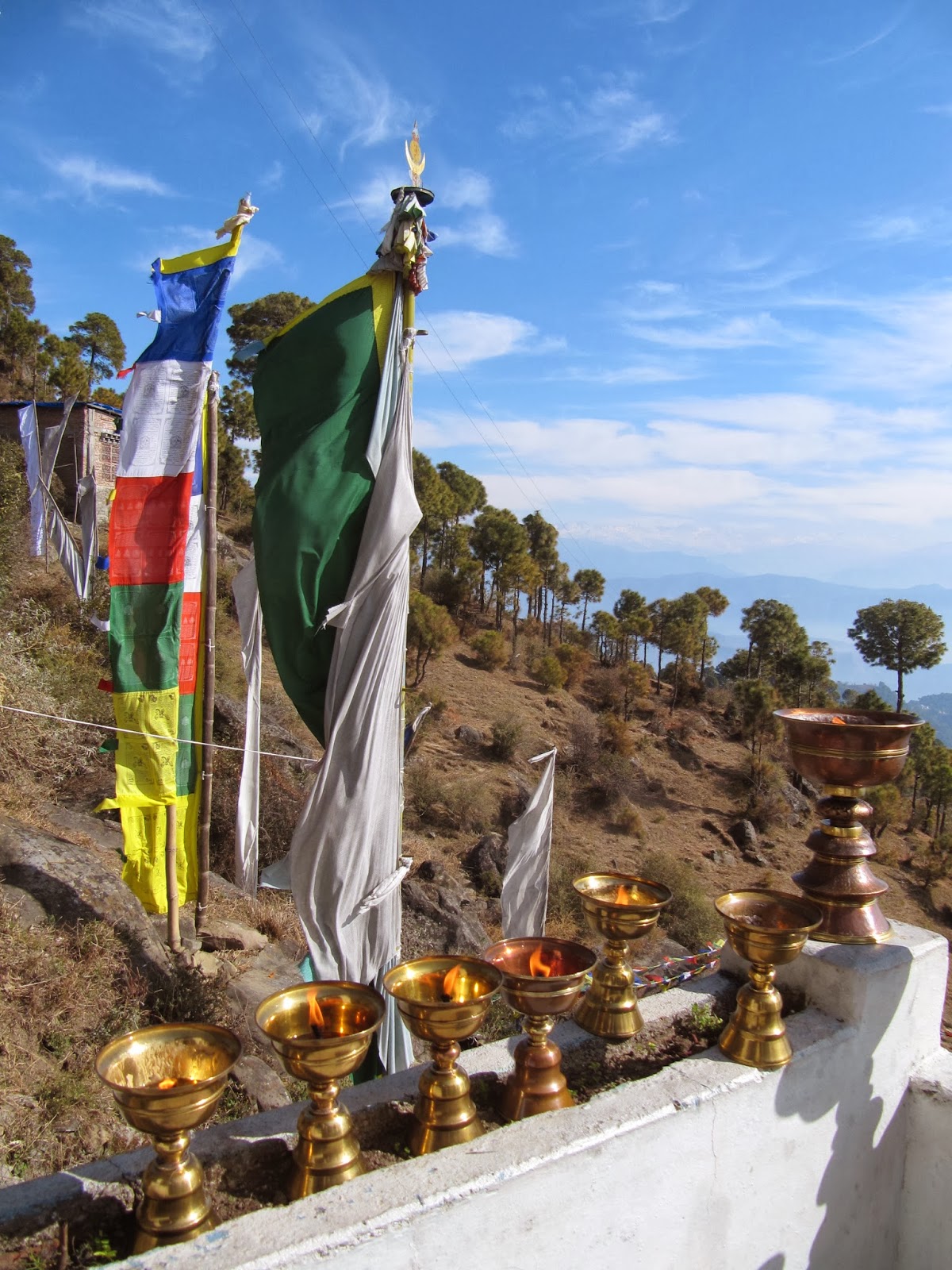
My co-teacher showed me these lamps. They are called "butter lamps" and you can buy one to make a prayer or offering. They cost around 50 rupees for one medium sized one. Some temples have special rooms just to burn these lamps, while other temples will let you burn them in a special area in the temple. 

 Burning butter lamps


However, the most famous cave here is the small one containing the supposed footprint of Padmasambhava. My co-worker was a little surprised when he saw it, he thought it was too big to really be his footprint....

 Padmasambhava's Footprint

 Butter lamps outside of Padmasambhava's Footprint

Shops before the temple selling many offerings to leave at the Hindu temple 

As we continued to hike up the mountain here, we came across a very big and beautiful Hindu temple. Though we didn't know much about the temple or Hinduism, it was still fun for me to walk around. One thing to note, that when you enter the grounds of a Hindu temple, you must remove your socks and shoes, even when walking around the outside of the grounds. Fortunately it was a warm and sunny day, so it wasn't a problem.


Inside the temple was smokey from all the incense burning. Around the perimeter of the inside of the temple, there were bells hanging every meter or so. As we and the other visitors walked around the temple, we rang each bell as we walked by. Very fun. Not sure about what the meaning of it is, but there is something about ringing a bell that makes you feel good.


After checking out all the caves and the Hindu temple, which took about 2 hours, we got back in our cab and headed to the actual lake itself. Stay tuned for Part 2 where I will introduce the rest of the holy places!

Tuesday, February 18, 2014

Up to the snow: Birling, Himachal Pradesh


On my first day off, my boss decided our staff should have a staff lunch, and we figured before lunch we’d make a quick stop to check out the view from Birling, a small settlement at the top of a local mountain which also happens to be one of the world’s top spots for paragliding. We knew there would be snow up there, so we figured it would be fun to play in the snow (down here in Chauntra it never gets cold enough to snow) and see the view. So, before going to the restaurant, which was near the bottom of the mountain, we jumped in two cars, one of our staff member’s cars and one taxi and headed up the mountain. I kind of felt like I was on a Korean ‘MT’.

The mountain road was a little scary at times. The road was only wide enough for one car (as most roads are here), though it of course supported two way traffic, which made passing both oncoming traffic and slow traffic ahead of us difficult, and at times scary, since there were rarely barriers protecting us from the steep mountainside next to us. 


However, things were going along smoothly until we reached the snow line on the mountain. Here we quickly realized that our little ultra compact cars could go no further in the snowy and icy conditions. Clearly no one up here owned anything like a snow plow. 


But, we figured we’d just walk the rest of the way up. It was only 11am, and our lunch reservation was for 2pm, so we figured we’d have plenty of time. The local folks from our staff assured us that we were just a quick hike from the top.

We found a small path on the sunny side of the mountain with not so much snow and started our assent. Some members of our staff were not prepared with proper shoes for hiking...


I'm not sure if it's a Tibetan thing, or a mountain people thing, or just a human nature thing, but we found that, just like in China, whenever we asked the locals "How much further?", they always reply in a way that makes it sound like you'll reach your destination in 10 minutes. However, just as in China, this hike took us much longer than expected. We finally reached the store near the top at 1:30.

Here we collapsed and had a cup of chai with some chips and cookies... and lots of water...


Around this time we called and informed our restaurant that we would be a bit late, to which we got a very angry response and hung up on. But, there was nothing we could do, so we continued our way up to the top of Birling.


Me and my co-workers at Dzongsar Monastary

Finally we made it to the top. There was some pretty fantastic views and despite all the snow, we felt quite warm. I've never had a snowball fight where I didn't mind picking up snow with my bare hands or wanted to take off my jacket before...


After throwing snowballs around for a little while, we made our way down, this time along the switchback roads, back to our waiting taxi. Then we headed back down the mountain to Bir for our, now very late, lunch. 


Upon arriving at the restaurant (which, by the way, is a very special restaurant owned by a German-Indian who accepts only advanced reservations and has a wood fired oven in which he makes pizzas totally from scratch using whatever ingredients are available in the morning market), we were told by the owner's assistant that we were too late, that we could not eat. We sadly walked out and wondered where we should eat when the woman came back out and informed us that, actually, she had already made our pizzas that we had pre-ordered, and if we didn't mind that they were now a little soggy, she could heat them up in a pan for us. We jumped for joy that we hadn't completely missed our meal and headed back in to enjoy our pizzas. 


After our late lunch, my boss took me for a little tour of her 'neigborhood' in Bir, which was basically a house in the middle of a field. But, the terraced land sure was beautiful.... 


I got back to the monastery where I'm staying just in time for dark, and was a good first introduction to the area...