Showing posts with label Wedding. Show all posts

Friday, January 3, 2014

Our Korean Wedding at The Korea House (한국의집)

Finally it's the post you've all been waiting for! It's taken me quite some time to get this post up, between honeymoon/ one month in China, and then almost immediately starting to teach a 7 week intensive course in Gangnam after coming back, and applying for jobs during every break time I have, I've had no time for blogging. I miss it so much! After some time, I've finally gotten this post up.

Our Korean Wedding Day:

It's amazing how much build-up there is to a wedding, but when the day arrives, the time just flies by before you know it. Our wedding was scheduled for 12:00pm on a Sunday afternoon, but that meant we needed to arrive at The Korea House by 8:30am to start preparing. As soon as we arrived, with our hanboks in hand, I was whisked away by the stylists and they immediately went to work on me.

The hair went quite quickly, actually. For a traditional Korean wedding, the hair style is quite simple, just parted down the middle and tied in the back. I had been growing my hair out for over a year in hopes that they would use my real hair for the hair piece, however that probably would have been impossible, so instead they just put my hair in a bun at the back of my neck and put a fake braided bun over it, which was strong enough to support the hair peice that would come later.

Next was the make-up. I must say, while there were some fake eyelashes involved, after they had finished with the make-up, I still looked like myself, which I can't really say about the photo shoot we had had the week earlier.

Getting my make-up done

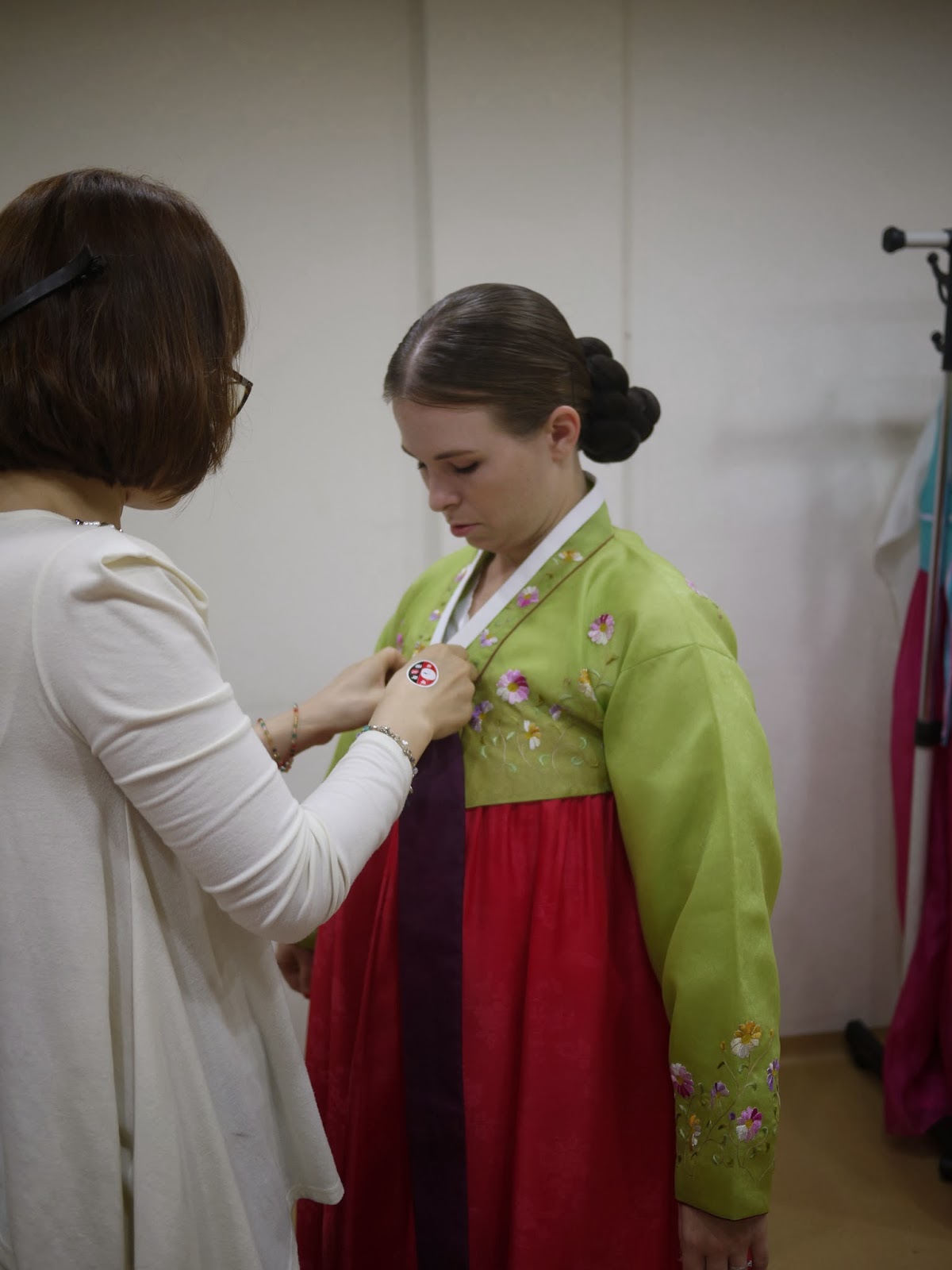
The make up and hair took some time, but once it was done, it was time to suit me up. First went on my own hanbok. This helper whipped it on in no time. However, since I had bought the hanbok myself, I had not bought shoes (I tried on the nice shoes in the shop, but found that they were all too uncomfortable, so I decided not to buy them). Since I knew that the men were given shoes, I assumed the bride would be, too. I was wrong however, and the woman nearly flipped out when she realized I didn't have any proper shoes to wear with my hanbok. Fortunately, my friend who had rented a hanbok got shoes with hers, so even though they were one size too big, I just wore hers instead.


Getting dressed

After I had gotten my own hanbok on, I was then given the bridal jeogori (top part of the hanbok) to wear over it. Actually, this worked out great since I found that the back of my hanbok sometimes flipped open showing my petticoat, and the bridal jeogori was very long in the back and covered the back of the dress.

Fitting the hair piece

My groom didn't take quite as long to get ready as there wasn't really any make-up for him. Once I was done, I headed out just in time for my photographer to arrive and take some pre-wedding photos. I should note that this is quite different from the American wedding ritual where the groom can not see the bride before the ceremony. Modern Korean weddings generally do the majority of the photography before the ceremony, unlike American weddings which would do couple photos after the ceremony.

Pre-ceremony photos

Since our wedding was at The Korea House in Chungmuro (which is open to the public and tourists can visit), the traditional hanok setting made for perfect photography. We recently got our wedding album back and we're quite satisfied with the way the photos came out (thanks again to Aand Studio).

Waiting in the 신부대기실

Once photos were done it was nearly 11:00, time to wait in the 신부대기실 or the bride's waiting room. While waiting here, guests can come up and take their photo with the bride (me!) before the ceremony. The groom and the rest of the family members wait by the door and greet guests as they come in.

At 11:45 I still had not received even one word of instruction on what to do for the wedding. I know that the men had run through their part earlier, but no one had explained anything to me. Just before it was time to head down, my two helpers (you can think of them as bridesmaids) came up and "taught" me how to bow. I thought I knew how to bow, I do it all the time in Korea, but this bow was totally different. Rather than getting down on my knees, I was taught to squat down all the way to the ground (being supported on each sides by my two bridesmaids) and then once I had gone down as far as I could, push back so my bottom was on the ground. Then I was told to lean forward and bow my back and head down, keeping my arms in front of my face, the big sleeves would keep my face covered.

We practiced this several times and it felt quite awkward but they assured me that I did a really good job, better than most foreign brides (probably helped by the fact that I could understand them as they couldn't speak English. I imagine most foreign brides must struggle terribly with the language barrier). After practicing bowing down, they whisked me down the stairs and into the house where I would wait for the ceremony to begin.

While waiting in the back, they also brought my mother in from the crowd. No one mentioned to me that she needed to play some role in this all. Suddenly, my helper was firing instructions at me at what my mom needed to do and what I needed to do. In the stress of the moment I was freaking out that I wasn't translating it right. "Ok, one more time... who follows who?" Finally the helpers very slowly explained what we all needed to do and I translated for my mother. Basically, my groom would put a wooden goose on a table in front of us. My mother needed to pick up the table and bring it inside and then we would all march out together in a line. 


The video here shows the rest of the process better than I can explain in words, so take a look! Thanks to Steve the Qi Ranger for our beautiful video.


We concluded the wedding with a little pansori, because, well, you can never have too much of that!


After the wedding was finished, it was photo time. First was photos with family, and then with friends. We were really overwhelmed by the number of friends that came to our wedding. There were even some friends who ducked out of the photo, believe it or not! 

(not) all of our friends

After the official photos were taken, my new husband and I were being pulled on all sides by friends wanting to snap photos with us in our wedding get up. But, way too quickly, we were whisked away by our helpers. I couldn't quite figure out why until we were brought into a room with all our family and we realized that we still had to do our pyebaek.


Pyebaek (폐백) is basically the Korean wedding tradition in which the groom's family welcomes the bride into the family. It is typically done privately with just family watching

There are several Pyebaek traditions. First we had to take the customary family photos. For my family, my friend Megan was a stand-in for my father who could not come to Korea.


Next we served rice wine (cheongju) to our families. I held the cup precariously over my hands covered with several layers of cloth while my groom poured and served it. Then our families took a few bites of the traditional snacks prepared. My mom and friend looked frightened to death of trying them.


Next it was time to toss dates and chestnuts into my cloth. The groom's mother and father each take a turn at throwing a handful of dates and chestnuts while we try to catch them in my cloth. The dates represent the number of girls we will have and the chestnuts represent the number of boys we will have... fortunately his mother completely missed and his father only got five in our cloth, so we're only having five children... don't want to think about what would have happened if they had both had better accuracy...

Getting ready to catch the dates and chestnuts our children

The only thing missing from our pyebaek was when the groom carries the bride on his back around the room. Don't know why we didn't do that, but I'll bet my groom paid them off because I know that was probably the part that he was least looking forward to.... suspicious...

Finally, it was off to eat with the rest of our guests. Actually, it was more like walking around and chatting with everyone we could and then finally when the staff told us that they would be closing up our buffet within the next 5 minutes we grabbed a plate of food for ourselves and scarfed some down before packing up our things and heading out. Then we went on to our after-party in Itaewon... which is a whole other story...

what we were wearing under the wedding garb


Tuesday, October 29, 2013

Preparing for a Korean Wedding

-->As I prepare to marry in September, here in Korea, I thought I would share some of the planning process with my readers. Perhaps some of you out there may be curious about Korean weddings and perhaps others of you are thinking about your own wedding here in Korea. If so, this will hopefully give you some insight into the process of planning a Korean wedding.

 Western wedding or traditional Korean wedding?

Type of ceremony:
The trend these days in Korea is towards having western style ceremonies wearing your typical white dress and tuxedo. Interestingly, however, many multicultural marriages here opt for the traditional Korean ceremony. I, personally, opted for this choice as the lesser of two evils. The western style wedding here felt too contrived for me (cutting a cake without eating it and pouring a champagne fountain that no one gets to drink). That’s not to say that the traditional Korean ceremonies are any less contrived, but as I don’t know how they were conducted in the past, I can’t see their shortcomings. Plus, I look terrible in white ^^.

Venue:
White weddings take place both in churches and in wedding halls. There is no dearth of wedding halls in Korea, so shop around and find the one that suits your taste best. Hotels tend to be pricier offering meals served individually to your guests during the ceremony. Wedding halls tend to be the more affordable option of the two, generally offering buffets where your guests will eat in a separate eating area, possibly with guests from other weddings as well as yours. Be sure to check out public facilities such as courthouses and even Seoul City Hall. These places tend to have very affordable rates for weddings (however, your guests may be eating in a cafeteria or you may need to find a restaurant to host your meal after the service).

Traditional weddings are offered in a number of places. In Seoul, Korea House, Namsangol Hanok Village and the War Museum of Korea tend to be popular locations, but do your research as you will find many others. Meal offerings will vary greatly between locations.

As for price, you will find that the sky is the limit for both types, however there tend to be a lot of affordable options for traditional marriages. If you are willing to hold your wedding in a public place, you could even have your ceremony conducted for free!

Photography:
Perhaps you have seen some spectacular Korean wedding photos and wondered how anyone could take the time to take those photos on their wedding day. That is because they don’t take them on their wedding day! While weddings here will always have a photographer snapping photos, the majority of wedding photos that get shown off at house parties and on Facebook are actually taken before the wedding. Visiting a photo studio can be a full day affair which includes make-up and hair stylists and a variety of costume changes. Why settle for one wedding dress when you could get your photo wearing five different ones? 


For the photos of the wedding day, many wedding venues are able to provide their own photographer if you wish. The price may be reasonable, however the photo packages may be fixed. If you aren’t happy with your venue’s offerings, most photography studios also offer wedding day photography as well. Shopping around for different photographer’s styles and prices will help you get a better idea of what to expect.

Attire:
For those who don’t like the idea of spending huge amounts of money on a dress that you will only wear once, there is good news. Women rarely buy wedding dresses/hanbok but rather rent them. Same goes for men as well. The bad news is that often times the rental price is often as much as purchasing a new one (albeit, the quality would be much higher).

Another option is buying a used hanbok. Hanbok, like wedding dresses and prom dresses, rarely are worn more than once, meaning that any used hanbok you purchase is like new.  I chose to go this route meaning that I could get a nice hanbok for half the price I would have paid for a new one.


The wedding attire is often supplied by the venue for traditional weddings. For my own wedding, the clothes for the ceremony are completely provided except for the skirt and shoes.


Paebek
What’s paebek, you ask? Paebek is the formal Confucian portion of the wedding ceremony where the bride and groom formally greet their parents and parents-in-law. During this portion of the ceremony, hanbok is worn by the bride and groom, and often the parents will also dress in hanbok as well. There are several traditions which take place during the paebek including bowing to the parents representing fielel piety, carrying the bride on the groom’s back, demonstrating both his physical strength and parents tossing chestnuts and dates and the bride and groom catching as many as they can, as chestnuts and dates represent the number of children the bride would later bear.


This ceremony is viewed to be quite important in Korean culture; however these days some people choose to opt out of this tradition. It is an added expense and not all couples view it to be important. Most Korean parents, however, will probably expect to have a paebek.
More information here: http://www.mybridestory.com/paebaek/

Reception:
Korean weddings do not typically have a reception as you may be used to in the west with music, dancing eating and drinking. Korean weddings tend to be short and sweet with just a ceremony and a meal. The meal may be served during the ceremony or guests may file into a buffet hall serving several weddings at once. If that isn’t sufficient for you, you may want to look into holding your ‘reception’ after the meal at another venue. Plenty of bars and restaurants are willing to open their space to group reservations and many small bars with low traffic on weekend afternoons will even allow you to book the entire bar without charge, as long as you bring a certain number of people. 


Photos and stories from my own wedding will be coming soon I hope! Just started teaching a new intensive course which will keep me busy for the next 7 weeks! 

Tuesday, October 22, 2013

Behind the scenes at a Korean studio wedding photo shoot

These days in Korea it is very popular to not just take photos on the day of your wedding, but to shoot some photos, either in a studio and/or outside, and publish them in a big photo album (not to mention all over Facebook, KakaoTalk etc. etc.). Before getting these photos done myself, I never imagined how much work goes into taking these photos, especially as the bride, but last month I learned for myself how much effort it takes to make one little wedding album.

Preparing for the studio wedding photo shoot 

First thing on a Sunday morning, we headed to the photo studio by 9am. I was immediately put in a chair and the hair and make-up artist spent over an hour doing my make-up and hair. I've never had my make-up done professionally like this before. After layers and layers of make-up and fake eyelashes, I couldn't even recognize myself. Then came the hair. She expertly straitened, curled, twisted, braided and hair sprayed my hair until it looked just right.

They also spent a little time on my husband-to-be as well. They quickly brushed his hair and styled it into place and put some make-up on him too, however, they only spent about 15 minutes on him compared with over an hour on me.

  
A book showing all the dress choices
Then it was time to play dress-up. They had a whole book of dresses and they asked me to go through and pick out four dresses that I wanted to wear throughout the day. It was too hard to choose from the photos, though, and in the end another assistant who was to be my personal attendant for the rest of the day just picked out several dresses she thought would suit me and let me try them on myself.

 Trying on my first long wedding gown
After I had picked out the first long dress, and my husband-to-be had been given a tuxedo to wear, we were set up for our first shoot. The most classic pose, sitting on a sofa with some flowers. But, getting the perfect pose is no easy feat. I had my attendant on one side tugging at my dress here and there to make it perfect, while the photographer continued to give commands, "turn your head left, tilt your head up, point your bouquet this way..." I can't imagine being a famous person who has to have people saying these things to them all day! I realized that all those natural looking poses I had seen in my friends photos were not so natural at all!

 
Adjusting this way and that for the perfect photo
 
Sitting on the floor in a dress this big is no easy feat
After more photos with the long dresses, I put on a short dress and we went out to the patio of the studio to shoot some more photos. It's amazing how some simple props can make for such nice looking photos.
 
Some outdoor photos
I must say, after nearly four hours of shooting photos, I must say that there was no end to the tiny photo studio's creativity in creating scenes for photos. While each scene was quite small, the whole studio fitting into the size of one two-floor house, the photos create an illusion of being taken in a really huge, vast space. Not to mention all the props and scenery they use, everything from giant balloons, to bicycles, to picnic tables to chandeliers, in the end the photos look amazing and as if we really went to many different places.
 Strange, yet interesting props
 
 
Got to love the astroturf...
But after hours of shooting photos, we were certainly exhausted and ready change into our street clothes and not having people adjusting  our our clothes, position and make-up every 30 seconds. Now we are looking forward to picking up our albums from the photographer and seeing the final results. While this tradition of dressing up in a wedding gown before the official wedding is quite different from my own American culture, it was quite fun to dress up and have people dote on you for hours on end, and get a book of nice photos after it's all done as well. I recommend getting wedding photo shoot!

We were exhausted by the end of the day

For those interested in the cost,  I think we got a fairly good deal, though I think they can personalize your photo package to fit any budget. We paid 1,500,000 for four albums: One album of studio photos, one album of photos from our wedding day (which they also shot for us), one small album of family shots, wedding shots, and paebaek shots for his parents and one larger album for my mother including some studio photos, wedding photos and paebaek photos. On top of that, they also will give us two framed 8x11 photos for free. Or we could have chosen one giant photo for free (which is usually put at the entrance of the wedding ceremony). We opted not to get that photo since we had no idea what we would do with such a huge photo after the ceremony though! Please visit the studio where we got our photos done:   
85-17 Nonhyun-dong
 Gangnam-gu, Seoul
Tel: 02-511-7350
Email: info@aand.co.kr

Monday, April 8, 2013

Anatomy of a Typical Korean Wedding


Korean weddings are somewhat of an enigma to the average foreigner here. On the outside, they look kind of like a western wedding, but, on the inside, there's a lot to understand. This is a guide for those who are planning on going to a typical Korean (western style) wedding to understand it a little better.


Upon entering the building, you may have to navigate your way to the particular wedding that you're attending. Most wedding halls have many weddings going on in a day, sometimes at the same time, so you'll have to keep a look out for the bride and groom's name written on a plaque indicating where they are located (Hopefully, for your sake, you can read their names in Korean).

Once you've found the correct wedding hall, it's time to greet the groom and the bride and groom's family. After walking through the line of formal greetings, it is then appropriate to approach the table where you are expected to give some money. How much you should pay depends on a lot of things like how close you are and if you have a guest, but for a co-worker or an acquaintance to I would suggest 50,000 or for a couple 100,000. Of course, if it's a close friend you'd probably want to give more, but you can decide for yourself how much to give. But, there is one rule you need to follow. Be sure to give money on a scale like this:
50,000
70,000
100,000
150,000
200,000 etc etc
Money should be given in increments of 10 and only on odd numbers (unless it's 100, 200 etc). Therefore, 75,000 is not really acceptable amount, nor is 40,000. Last thing, make sure you put it in a white envelope with your name on it so they can record how much you paid.

After you pay your money, if you're good friends with the bride, you may want to go check out the bride's viewing room where she sits before the wedding begins. You can take your photo with her or say hello and congratulations.

Then it's time to find a seat in the wedding hall. Some places have seating around tables and they may serve the meal during the ceremony which leads to lots of talking and drinking while couples take their vows. The presider of the wedding may shush the audience and the audience may hush for a moment before continuing their conversation. Other places are a little more respectful and have chairs set up for viewing the ceremony as a westerner may expect, though the presider may still need to hush people even when there is no food and spirits to distract the audience.


First, the mothers of the bride will walk up to the altar first and light some candles. You'll notice here that the mothers are wearing pink and purple. Pink is the typical color for the mothers of the bride and groom to wear for the ceremony.


Next the groom will walk down the aisle, and then it's time for the bride to make her appearance. At this particular wedding, they had a screen showing the bride as she walked from her viewing room to the hall, then she joined her father to walk her down the aisle.  


Then it's time for the presider to give a speech about love and marriage. Usually, if it's not a church wedding, the presider will be a member of the community like a college professor. However, I am only guessing that they talk about love as marriage, because as I mentioned earlier, Koreans tend to ignore this part of the ceremony entirely and chit chat with the people around them.


Here comes the actual Korean traditional part of the ceremony. The bride and groom show their respect to the parents and bow before each of them. Fortunately, since bowing is so low, the cameramen generally capture all this on film and display it on a screen so all can watch.


Then comes the part of the ceremony which I don't understand at all , the cutting of the cake. Here, our groom has a giant sword like apparatus to cut the cake and photographers zoom around to capture the important moment where the cake is cut. And then the sword knife is taken away, as is the cake, before anyone gets any ideas of eating the silly thing. It goes into a box and I'm still not sure where it goes as it's not with the bride and groom since they usually jump into their wedding car and zoom off for the airport for their honeymoon after the service, just like the olden-days. I'm sorry, but if you're going to put a cake in front of everyone I think it should be eaten. I hate that this ceremony is only about photo ops and not about tradition and meaning. Sorry, rant over.


Then the ceremony ends and the bride and groom walk down the aisle as husband and wife.


But it's not over yet, now it's photo time! First there are photos taken with the family and extended family. Then after that, it's photo time with friends. If you're a friend of the bride or groom, you can get in the photo too!


The bride throws the bouquet at the wedding too, but the tradition here is a little different. In America all the single women line up trying to catch the bouquet, because it means that you will be the next to get married. In Korea, if you catch the bouquet and you don't get married within a year, they will not get married for the next 10 years. So.. usually since no one wants to risk this bad luck they choose a friend who is already engaged to catch the bouquet.


And then there is the food. Most weddings will have a buffet. If you are served at your table by a waiter it means that they probably paid a whole lot of money for the event. The buffet is usually after the ceremony, but once you give your money you get a meal ticket to enter, so theoretically you could go straight up to eat. Fortunately they show video feeds of all the weddings going on (since all the various wedding parties going on for the day eat together in the same hall) so that you can eat your meal and watch the wedding without missing a thing. It seems as though as long as you leave your money, no one really minds if you're in a rush and can't stay for the ceremony and just grab your meal and run.


After the ceremony the couple changes, usually into couple shirts, and jumps into their wedding car and heads for the airport to leave for their honeymoon. The bride and groom usually leaves the same evening or the next morning for their trip and will often stay at an airport hotel if they do leave the next day. If you don't believe this, just take a drive to the airport on a Saturday afternoon and count how many of these decked out cars you see!


Koreans do not generally: 
Have bridal showers
Have bachelor/Bachelorette parties
Give gifts besides money
Dance at the wedding
Have bridesmaids/ groomsmen
Exchange rings during the ceremony

Monday, September 17, 2012

Wedding Photography


Weddings are stressful events to be sure,  and after being part of two weddings (well, being in one and planning the shower for another) I have decided one thing. Weddings are perhaps worth it mostly for the photos. Taking the photos and posing for the photos and editing the photos and getting the final photos. While I probably should have been doing more important maid-of-honor duties, I decided that I would be the unofficial photographer for the day. It was the one skill I could lend to the bride since I'm not good at stuff like make-up and dresses and shoes.


I highly recommend cupcakes instead of a real cake for your next wedding. It's cheaper and when people aren't hungry for cake after their big meal, they're much more likely to snag one later while they're dancing and working up an appetite.