Showing posts with label Restaurants. Show all posts

Friday, August 23, 2013

신촌황소곱창-종로점 Sinchon Hwangso Gopchang- Jongno Branch


My my, it's been such a long time now since I left Seoul, but now that I have a little time, I'm going through some old posts I had planned and never got to write. Here is one about eating 곱창 (gopchang/intestines) at 신촌황소곱창 in Jongno. I have had gopchang several times before, but usually in Hwanghakdong where the most popular variety seems to be 양념곱창, a rather sticky sweet and spicy form of the gopchang, which I must say was pretty good as far as intestines go. However, one commenter, the author of The Seoul Patch blog mentioned, and I quote:

 "Technically, what you ate was gopchang. However, that gunk with the ddok, gochujang and sesame seeds on it is to gopchang as a Mickey D's burger patty is to a sirloin steak. I'm far from an expert, but I want to suggest you try again, and stay away from pojangmacha for it. Really, if you liked that okay, you'll love the unadorned item, cooked on the table grill, with other organ meat like liver and kidney, and onion, garlic and potato slices as well. Delicious!"

I always wondered about the validity of this statement after I read that, but never really was daring enough to try again until about a week before I left Korea. A friend of mine invited me out for dinner with her friend and they had already made plans to come to 신촌황소곱창. They asked me if it was ok, though I couldn't really have said no, even if I had wanted to...


We arrived here and were escorted to one of the only empty tables left available. Apparently this is a really popular joint for intestines consumption and they claim to be a 60-year old restaurant. However, it also seems to be a local chain, so it's hard to say how long this particular establishment has been around...


I let my friend order, since I'm clearly clueless about this particular cuisine. While waiting for our gopchang, out came a very interesting side dish: Liver (간) and tripe (천엽). While it wasn't terrible, it is certainly not something that I would order every day.


Next, they brought over our main meal beef gopchang with onions and green onions. The woman grilled it up for us on the table in front of us. I don't know why, but the thought of eating gopchang scares me a little, but I toughed it out, and, you know what? It wasn't bad.


This was certainly a dinner of new foods for me. They brought over another side dish of mussel soup. My friend laughed at me because I didn't know the difference between oyster and mussel. Apparently oyster shells are very bumpy and mussel shells are very smooth and black. I'm so clueless about seafood..


As usual, once we had eaten most of our meal, they then brought over the bap for some bokkum. Now who doesn't love a little bokkum bap, right?


신촌황소곱창 -Jongno branch is located in the Jongno nightlife area between Jonggak station and Jongno-3-ga station. From Jonggak station exit 4, turn left into the first street on right. Turn left on Samil-daero-7-gil. The restaurant will be on your right.

서울 종로구 관철동 12-23번지
 Gwangcheol-dong 12-23
Seoul Jongno-gu
02-735-6698

View 신촌황소곱창 in a larger map

Wednesday, May 1, 2013

전대감댁 Jeon Daekam Daek


Today I met one of the staff members from KOCIS, the makers of The Korea Blog for lunch. She brought me to a really cute restaurant on the Sejong Village Food Culture Street (세종마을 음식문화 거리) near Gyeongbukgung Station. 

 
전대감댁 is the name of the restaurant 전 (Jeon) is a family name, 대감 (Daekam) a word meaning a high ranking official from ancient times and 댁 (deak) is the honorific form of house (집). So, this could be called Mr. Jeon's House in English.


The food was very nice and light. I didn't have that heavy uncomfortable feeling in my stomach I often have after eating a typical Korean restaurant meal. We just ordered two dishes, 'today's special' which was a beef and radish soup and a grilled pork dish with cabbage. It was just the right amount of food for two people.


However, the thing I liked most here was the ambiance. Water fountains gurgling, fish swimming around lilypads and even an eating area open to the sky above (I guess it was covered by glass).  Food and drinks served on really beautiful ceramic plates, bowls and cups.


If you happen to be in the area,  be sure to stop by. Great for lunch, however, it seems to be most popular in the evening for its 전 or Korean pancakes.


전대감댁/ Jeon Daekam Daek
070-4202-5170
서울 종로구 체부동 184
Chebudong 184, Jongno-gu, Seoul

Friday, April 26, 2013

Chinese food and the Multicultural Food Street of Ansan

Entry to the Multicultural Food Street (다문화음식거리) in Ansan

If you happen to be sick of your typical jjajangmyeon and tangsuyuk (Korean style Chinese food) and are looking for some more authentic Chinese food, the Multicultural Food Street in Ansan, Gyeonggi-do is a safe bet. While not particularly close to Seoul, (takes 1hr and 15 mins from Dongdaemun station on line 4), it's a great day trip and definitely worth the time it takes to get there. And if you live in the area, then you have no excuse not to go down here and check it out!


While Chinese food is not the only 'multicultural food' on this street, I would say it makes up a large portion of the restaurants. However, keep your eyes open for Thai, Vietnamese, Russian, Indian, Nepali, and Middle Eastern restaurants as well. While the 'multicultural street' is a good starting point, the whole area sports countless restaurants serving up international cuisine along with stores to pick up ingredients if you prefer cooking things at home.


How can a street such as this, exist out in the middle of the 'suburbs' of Seoul, you ask? This neighborhood has developed thanks to the booming migrant worker population in the area. People come from around the world, particularly from Asia, to work in Korea's factories. Naturally, as people come from other countries, they bring their food and culture along with them. 


While prices here might be higher than actually eating in China or Southeast Asia, prices here for food are quite reasonable. Cakes and snacks are abound, tantalizing the passerby with their exotic allure. The moon cakes pictured below were just 1,000 won each as was a huge slice of the bread above. In fact, the biggest problem you may have is reading the menu as they often don't have any Korean explaination, never mind English. I think the sign of a truly authentic restaurant geared towards natives is when they don't even bother to translate the menu. However, as long as your Korean skills are passable, everyone I came across spoke fluent Korean, so you will still be able to ask what dishes and foods are.

 月饼 (yue bing) Moon cakes, 1,000 each

We came here with the intent of eating Chinese food, but while I've been studying Chinese for 8 months now, I'm still not able to read menus or ask what things are in Chinese (or at least not able to understand the answer), so we wondered around for a good while trying to settle on a restaurant based on very little information. Finally, we passed one restaurant with some people inside and peered in to check it out. There was no menu on the wall, but we saw people eating things out of pots, so we decided to wonder in and check out what it was all about.

 麻辣香锅 (ma la xiang guo) 

It turns out that there was no menu because there was only one thing on the menu:  麻辣香锅 (ma la xiang guo), a Sichuan dish. Of course, at the time, I had no idea what that was, but upon asking my Chinese conversation partner, 'ma la' means 'spicy', actually a particular kind of spice which comes from some small seed like things in the dish, 'xiang' which means 'delicious' and 'guo' means pot. So, litterally translated, this would be a 'spicy, delicious pot'. I like spicy and delicious things, so it was perfect for me. 

Choose your own meat and veggies

Ordering wasn't hard, albeit, not what I expected. Were brought up to a salad and meat bar and given two pots. We were instructed to fill one with all the veggies we wanted to eat, and one with all the meat we wanted to eat. They asked us how spicy we wanted, and I told them medium. Then we handed over our pots to the staff who weighed them to figure out the price and then cooked them up.


Upon describing this dish to other westerners, I got the immediate response, "Ah, so you had Mongolian Grill!". I didn't know what Mongolian grill was, but after some research I found that 蒙古烤肉 Měnggǔ kǎoròu, Otherwise known as 'Mongolian grill' is in fact, not Mongolian at all, but a Taiwanese invention that gained popularity and spread to the west. The idea for ma la xiang guo is similar, but you don't get to choose your sauce. And boy was I glad I went with medium and not spicy, because my mouth was on fire throughout the meal. I think even ordering this dish in its mild form would have been sufficient on the spiciness for me.

The finished product!

Not long after, a pot filled with goodness was brought to our table. We may have been a little excessive when choosing our ingredients... everything looked so good, it was hard to say control ourselves.


Needless to say, the two of us left the restaurant bursting at the seems....


In short, if you happen to be craving foreign food, or missing China, Ansan is definitely the place to be.


The Multicultural Food Street (다문화 음식거리) Is located directly in front of Ansan Station. From the main gate of Ansan Station, cross the street through the underground passage, and when you come up, take the stairs on your left. The Multicultural Food Street will be on your left. Don't just stick to the main drag, many restaurants are located on side streets or past the end of the street.

Wednesday, April 3, 2013

리북 손만두: LeeBuk Son Mandu, North Korean Restaurant


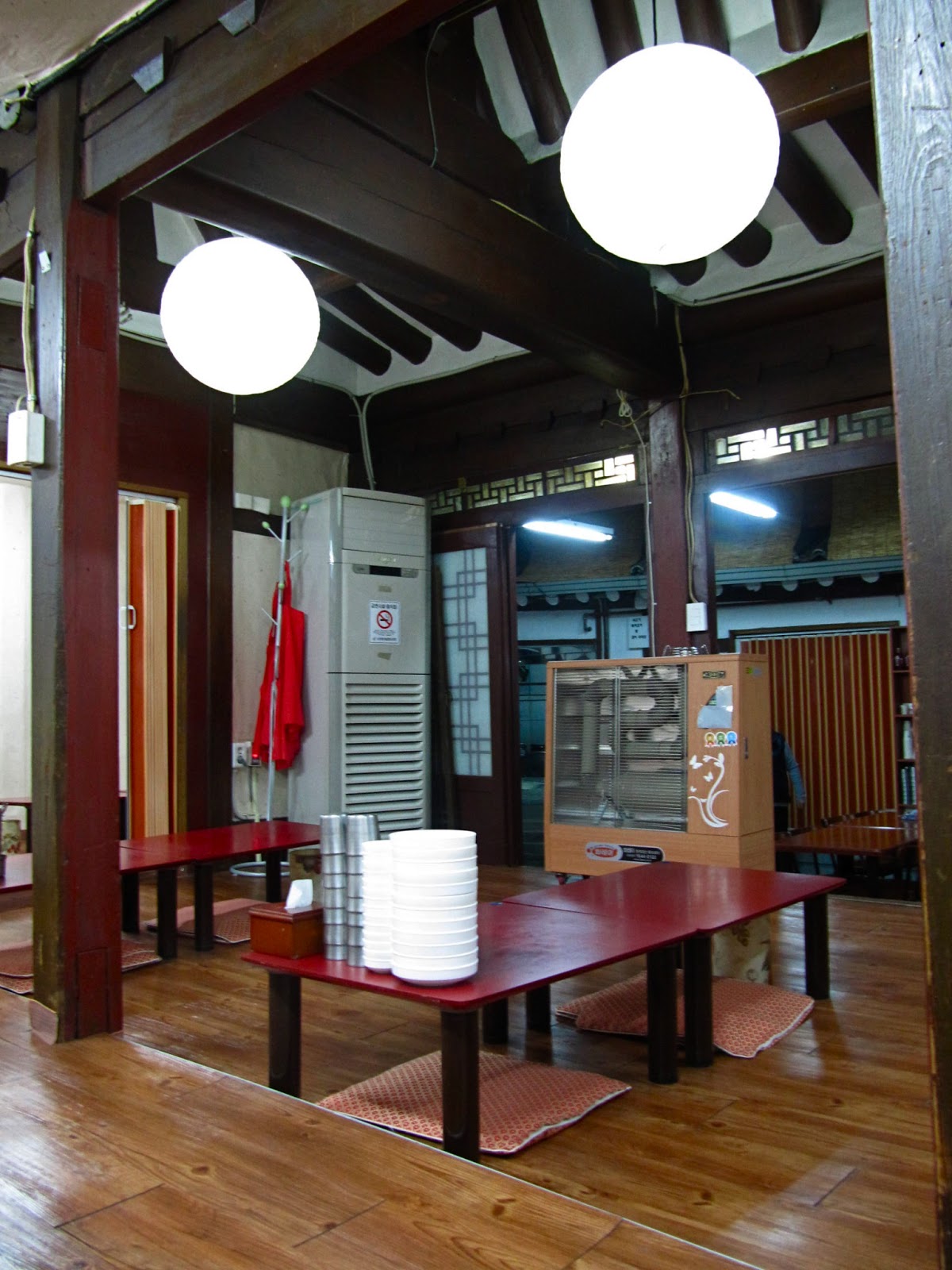
LeeBuk Son Mandu is not your typical mandu place for many reasons. First and foremost, it's a North Korean style restaurant, which is what initially drew me to this place. However, that's not all. It also happens to be in a hanok located in the least likely of places to find a hanok, directly behind city hall. Completely surrounded on all sides by modern and semi-modern buildings, there is no way you could accidentally stumble upon this restaurant. There is practically a tunnel of alleyways which lead you to this restaurant. It's not hard to find though, just follow the signs for '리 (이) 북 손만두!

First turn of the alleyway, 

 Second turn of the alleyway,

Aha! Finally, we found the entrance!


As I mentioned, this restaurant is located in a hanok. They've put a roof over the madang (courtyard) to make more space, but other than this, many of the beautiful hanok features remain. 


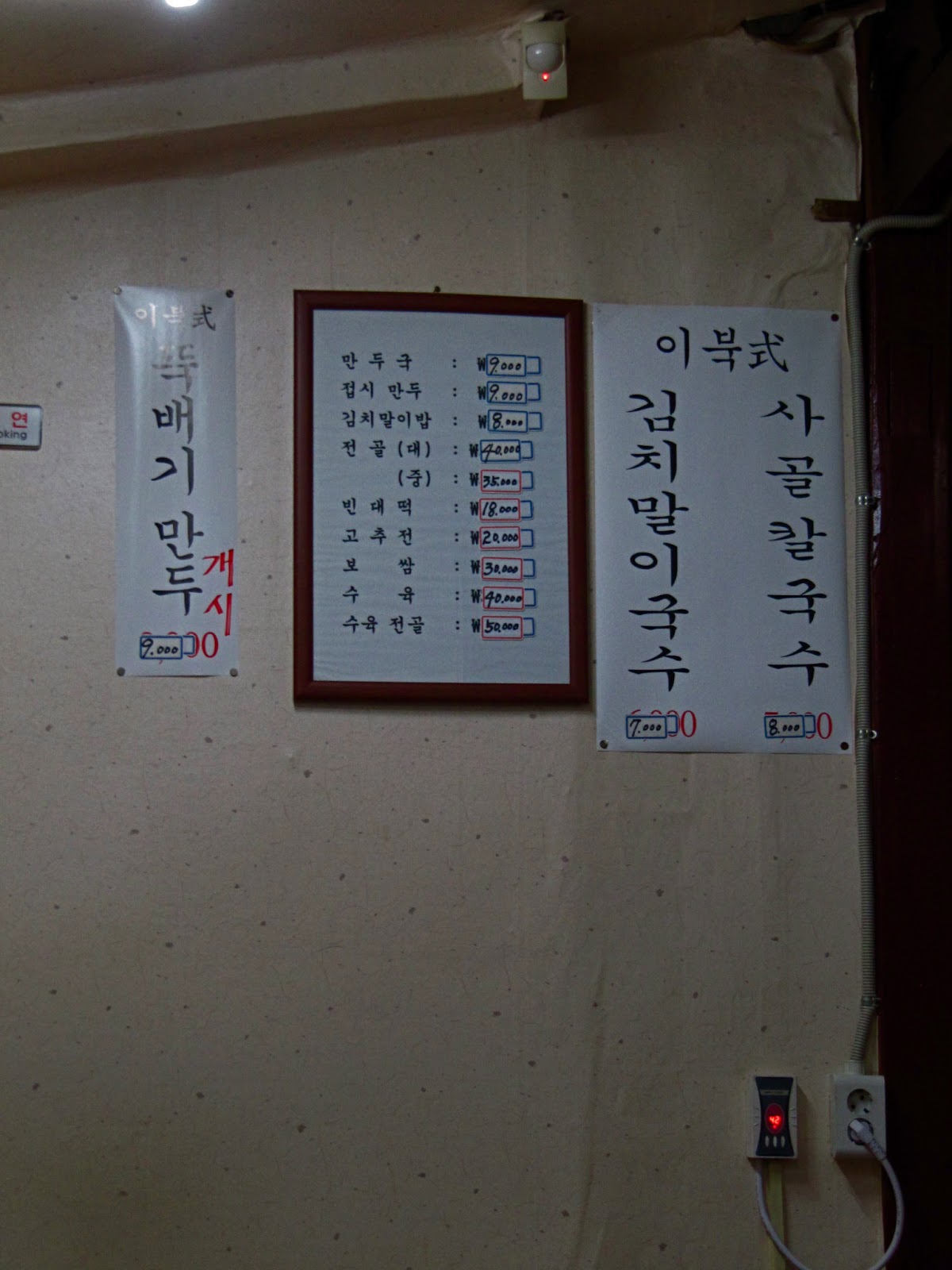
Sinc the name of this restaurant contains the name '손만두' meaning homemade mandu, ordering the mandu went without without questioning, we actually went with the 만두국. However, after previewing some blogs on the Korean blogosphere, I saw that most people were actually raving about the Kimchi mari bap (김치마리밥). It is not the sort of mari, as in a roll, but as in the meaning of 말다 which means to put cooked rice into water. So, here, kimchi mari bap means rice in a bowl of water and kimchi. There is also a kimchi mari guksu which is the same but with noodles as well. Actually, I tried ordering it but the night we went they were all out, so I had to go with the kimchi mari bap.

Here's our table


 Ok, first the manduguk. Ok, I have to say I was a little dissapointed here. The mandu were great, don't get me wrong, but the soup was like water... sorry, peppery water. It's not just here that has disappointed me like this before, I've found that for some reason it's hard to get a manduguk with a decent, flavorful (meaning not pepper flavored) broth in this country. The best I've had was in Gangwondo at Namkyeong Siktang. If I were you, I'd skip the guk and just get the mandu. Or perhaps try the 뚝배기만두


But, as the bloggers would suggest, the real star of the evening was the kimchi mari bap. I had low expectations for this one, because, well, it's a bowl of kimchi and rice in ice water. it sounds pretty awful. However, this was surprisingly refreshing and delicious, and though you can't see it there is a surprisingly large amount of rice in the bottom of the bowl. The best way to describe the flavor of this is 고소해요, a word which doesn't directly translate to English, but means having the taste of sesame oil. It's a good thing though!

My friend who came with me wrote a blog post about this restaurant as well, but with many more selections as he came back two more times later without me. Check out his post here.

리북 손만두 Leebuk Son Mandu
17-13, Mugyo-ro, Jung-gu, Seoul
서울 중구 무교로 17-13 (무교동)

Getting here is slightly tricky, but not too bad:

City Hall Station (Seoul Subway Line 1, 2), Exit 4.
Go straight 60m and turn right onto Sejong-daero 20-gil Road.
Go straight 150m and turn left at the 4-way Intersection.
Go 50m and turn left at the first corner.
Turn left onto the the small alleyway between 7-Eleven and Jeil Garden (제일가든).
Libuk Sonmandu (리북 손만두) is located at the end of the alley.
http://asiaenglish.visitkorea.or.kr/ena/CU/CU_EN_8_1_4_4.jsp?cid=757746


View 리북 손만두 Leebuk Son Mandu in a larger map

Saturday, March 30, 2013

Foods of Pyeongchang: Doam Siktang (도암 식당)


One of Hoenggye's most popular restaurants is Doam Siktang (도암 식당). On any evening in the peak season you can expect to see the restaurant full with people. By far the most popular dish here is the Gangwon-do specialty, Oh-sam-bulgogi (오삼불고기). '오' standing for 오징어 (squid) and '삼' standing for '삼겹살' and of course 불고기 here does not mean beef, but perhaps just refers to the fact that this is cooked in a similar fashion to normal bulgogi, well-marinated and cooked on a pan over a flame on the table.


Gangwon-do, these days, seems to be doing a lot of creative things with their makkoli. One of which I see the most varieties of is corn makkoli. While I'm certainly not against getting creative with makkoli, this particular flavor is just one I can't really enjoy. I have tried at least 3-4 different brands of this, and each time we are left sorely disappointed....


Anyway, on to the food. Above is our oh-sam-bulgogi just after it arrived on our table. A few fresh vegetables, but lots of meat and squid.


 While it doesn't look particularly appetizing in the first photo, when it starts cooking it starts looking tastier and tastier. I'm not generally a huge squid fan (though I like it more than other sea creatures), I really do enjoy the squid in this dish. I still am not a big fan of the tentacles yet though.


And of course, when you've eaten 5/6th of your meal, that means it's time to order the bokkumbap. Turn that heat back on and fry up your rice with the remaining meat and sauce. 


Yum yum!

Doam Siktang is located right in the center of downtown Hoenggye, directly to the left of the rotary if you enter coming from the direction of the highway.  The main eating area is actually on the second floor, but they use the first floor for overflow when it gets too crowded.

강원도 대관령면 횡계리 323-6 
Gangwondo, Daewalleong-myon
Hoenggye-ri 323-6
Phone:
--> 033-336-3816


View Doam Siktang 도암식당 in a larger map 


Sunday, March 24, 2013

Blue Fish: Seafood in Gangnam


Several weeks ago I was invited to a meal at Blue Fish, a Santorini themed sashimi restaurant in Gangnam. They specialize in a from-the-sea-to-the-plate experience making sure to bring you only the highest quality seafood available. This is their first location to be opened, but knowing that this is operated by the same company that runs YeonTaBal, you can know what to expect. 


The restaurant has many custom, privatized eating areas for groups, and another open eating area for smaller parties.


I particularly liked the ambiance here, it sort of felt as if we were underwater.


As customary in Korea, the tanks are out in the open for all to see. I was assured that dead fish are never served, which apparently is something that does happen in other local restaurants.


As to be expected here, the banchan are served almost like an art form.


We ordered one of the set menu options. First we were brought over this exquisite plate of sashimi...


And then our own personal chef came over to personally cut up and serve our main dish of sashimi.


While this was quite a huge amout of food, my hosts insisted on ordering two portions of 생선조림 (Saengseon Jorim) which is thickly stewed fish in spicy sauce.


Waste not, want not, the parts of the fish that we didn't eat as sashimi were thrown into this pot and brought over to us as maeuntang, or spicy fish stew.


Though I was already bursting through the seams, more came out. A basket of yummy twigim (deep-fried vegetables) and 생선구이 (Saengson Gui), fried fish.


Finally, we were served a light desert of fruit, a perfect ending to this huge feast.

As you might be able to guess from the photos, this is definitely a high-end restaurant. It's a good choice if you want to go out for a special occasion or impress a girlfriend or client, or if you just have a craving for high quality food. Since Blue Fish oversees the fishing and transport of all their seafood, prices for the course menu start from 65,000 per person and go up from there depending on what kind of fish you order. They also have a lunch menu to check out, too.

서울 강남구 
논현동 165번지 
서희빌딩 2층

SeoHui Building 2F
Nonhyup-dong 165
Gangnam-gu, Seoul

Phone: 02-547-9223
Website: http://ibluefish.co.kr/main.php (Korean only)


View Blue Fish in a larger map


**I was invited here by staff of the restaurant with the intent of publishing on my blog. I did receive a free meal for writing this blog post. **