Showing posts with label Hinduism. Show all posts

Tuesday, March 11, 2014

Baijnath, Palampor, and a toy train

 Indian buses look just like how you would expect them to look... 

 With only one day per week off from working in the monastery, we looked forward to our Fridays off a lot. Unfortunately, our day in Tso Pema was the last bright sunny day we had on our days off. The next Friday it poured and we did nothing but lay around the monastery and sleep. And the following Friday, after a week of beautiful weather, we woke up to thunderstorms again. But, as my days in India were quickly flying by, I couldn't let my last Friday off from work be ruined by another rain storm. So this time, my Tibetan co-worker, my new American co-worker put on our raincoats and our umbrellas and trudged out into the rain to catch a bus to the nearby town of Baijnath.

The good thing about traveling by bus is that you can go between towns for almost nothing. I think we paid about 20 rupees or so for this bus ride, which is about $0.33. Though, the downside is that the buses are crowded and take more than double the time of driving.


 In Baijnath, there's really only one thing to see, and that is the town's namesake, the Baijnath temple. This is a temple dedicated to Shiva and it is ancient. The temple was constructed in 1204AD and apparently there was even a temple on these grounds before this one was constructed. So, basically folks have been praying here for a really long time.


As uncomfortable as I sometimes feel in temples which are not my own religion, I must say, being in Hindu temples was one of the most uncomfortable experiences for me. I know in a church I should cross myself or kneel in a pew, and I know in a Buddhist temple I should bow a few times, but in a Hindu temple I really have no idea what I should/ should not be doing. There's often a lot of different things going on in different places... people ringing bells, people making offerings, people chanting, etc. etc. Sometimes a lot of people are just sitting around on the floor doing... stuff... that I don't have any clue to even make a guess at what they could be doing. 

Holy Cow

 One thing that I noticed in Hindu temples is that you have to take off your shoes and socks. And not just when entering a building, like in Buddhism, but when entering the temple grounds. Which leads to very cold feet when it's raining, or very painful feet when walking over gravel to get from one part of the temple to another.  

Another thing that India seems to be very strict about is photography in religious places, like temples. There are signs everywhere about no photography, and in Delhi and Dharamsala I had to leave my camera at the front gate of temples. However, here in the country they were a bit less strict, and despite the warnings everywhere about not taking photos, since many Indians were also taking photos I decided I might as well go for it...

 Palampur Bus Station

While the temple was beautiful, it was not so big, so 20 minutes of exploration of the temple was more than plenty. We then had a quick snack and the boarded the next bus headed for the city of Palampur, the nearest 'big city' to our monastery.


We didn't really need to buy anything in particular here, so we just kind of wandered here and there. Since I was kind of in the market for some Punjab style clothes, I kept my eyes open. I missed a few good deals here because I thought I could find something better later... But, the problem (or good thing, however you choose to look at it) with buying clothes in India is that it seems most people prefer tailor made clothes. So, it's very easy to find textile shops and tailors, however, finding shops selling pre-made clothes can be quite challenging. The particular store shown above had a mix of both pre-made clothes and fabrics for tailor made things. 


Cows in India are not just for the country. It's not unusual to find cows even in the middle of the city, sadly eating trash (Though, I'm sure even the country cows are eating a lot of trash, too).  Our region had put a ban on plastic bags because, not only the obvious problem of too much waste, but also because animals like cows often eat them and they are eventually killed by the plastic in their stomachs. However, despite the ban on plastic bags, it was still possible to find them here and there, and there is still plenty of plastic used in packaging. Ah, the joys of consumerism.

 Palampur Toy Train Station

We spent about two hours wondering around Palampur and then it was time to head back. We had heard about the famous "toy train" of Himachal Pradesh and wanted to give it a try.  The train is called a "toy train" because it is a smaller gauge (2ft 6in) than a normal train. The train is also incredibly cheap. From Palampur back to the monastery in Chauntra was just 10 rupees ($ 0.16), though you get what you pay for. The train ride takes nearly triple the time it would take by car.


We checked the schedule online which told us that the train left at 4:30pm from Palampur. Upon arrival, they told us that it would be 4:45, though I shouldn't have been surprised when we took off no later than 5:00pm. The train inside was basic, but it had a toilet in each car. We were lucky to get seats, as one person offered us his seat because he was getting off soon. Otherwise, at least one of us would have been standing for the ride. 


Upon reaching Baijnath, the train stopped and all the people cleared out. It seems as though most people only go as far as Baijnath. We waited in the train car for a little while, but finally we got impatient and went outside. We were quite surprised to find that besides our car and the one after our car, the rest of the train was gone! We bought some chai and street food and waited patiently for our engine to reappear. It finally did, and they coupled the train back up again, this time which much fewer cars and filled with much fewer people.

 Tracks near the "swimming pool" during the day...

We continued the rest of our ride back to Chauntra and arrived at the "swimming pool", which is what the locals refer to as the reference point for the station. The "station" is not on any road and there are no signs. Basically, to find it, you've got to walk down a hill behind a house, then keep walking down until you find the tracks. Then follow the tracks until you find a tiny hut on the side of the tracks. That tiny hut is the station and it happens to be across from a swimming pool. So, if you ask locals where to catch the train, they may tell you to go down to the swimming pool.

We arrived around 7:30pm, in the rain and pitch black night. Had to use my cell phone flash light to find the way back up to the road and back to the monastery. While it wasn't the most exciting day in India, it was good to get out of the monastery, despite the rain.

Wednesday, February 19, 2014

Tso Pema/Rewalsar part 1: Caves and Hindu Temples


For my second day trip, my Tibetan co-teacher and I headed out to a very holy town for not only Buddhists, but also for Hindus and Sikhs. The area is called Tso Pema in Tibetan, but you may also hear it called Rewalsar in its Hindi name as well. Tso means lake and Pema means lotus, so it is actually Lotus Lake.

According to Wikipedia:
The famous Rawalsar lake ('Tso Pema' to Tibetans) is associated with Padmasambhava (also known as Guru Rinpoche), who is recognized as a second Buddha. One version of a legend has it that the king of Mandi had Padmasambhava burnt alive after rumours that the Guru had attempted to teach his daughter the Dharma, which was not accepted then. The pyre burned for a full week, with great clouds of black smoke arising from it, but after a week, a lake appeared at the spot where he was burnt and Padmasambhava manifested himself as a 16 year old boy from within a lotus in the middle of the lake. The king, repenting his actions, married his daughter with Padmasambhava. It was from Tso Pema that Padmasambhava went to Tibet to spread Vajrayana Buddhism.


However, our first stop here was not the lake, but the caves in the mountains nearby which make this area so famous for Buddhists. It was here in these caves that Padmasambhava found enlightenment. Padmasambhava is considered a second Buddha and the one responsible for bringing Buddhism to Tibet. There are four important caves here, although, from the outside you would never know that they were caves. Outside of the caves, houses and roofs have been constructed and inside the caves the floors have been tiled and stairs have been put in, so actually they have become caves converted into temples or shrines.


Inside the first cave: A portrait of a famous lama

 Some cave-like walls still remain...

 Butter Lamps

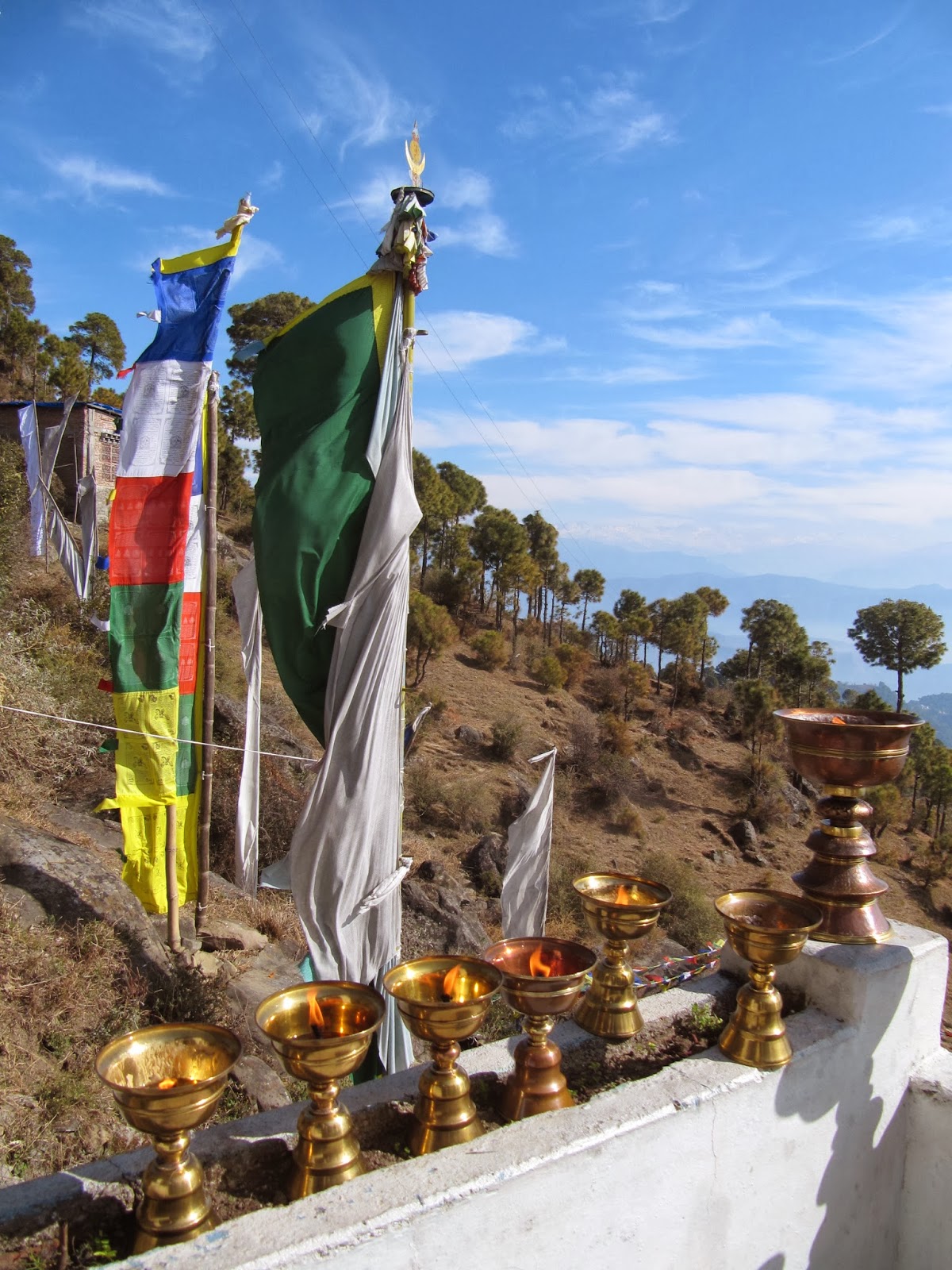
My co-teacher showed me these lamps. They are called "butter lamps" and you can buy one to make a prayer or offering. They cost around 50 rupees for one medium sized one. Some temples have special rooms just to burn these lamps, while other temples will let you burn them in a special area in the temple. 

 Burning butter lamps


However, the most famous cave here is the small one containing the supposed footprint of Padmasambhava. My co-worker was a little surprised when he saw it, he thought it was too big to really be his footprint....

 Padmasambhava's Footprint

 Butter lamps outside of Padmasambhava's Footprint

Shops before the temple selling many offerings to leave at the Hindu temple 

As we continued to hike up the mountain here, we came across a very big and beautiful Hindu temple. Though we didn't know much about the temple or Hinduism, it was still fun for me to walk around. One thing to note, that when you enter the grounds of a Hindu temple, you must remove your socks and shoes, even when walking around the outside of the grounds. Fortunately it was a warm and sunny day, so it wasn't a problem.


Inside the temple was smokey from all the incense burning. Around the perimeter of the inside of the temple, there were bells hanging every meter or so. As we and the other visitors walked around the temple, we rang each bell as we walked by. Very fun. Not sure about what the meaning of it is, but there is something about ringing a bell that makes you feel good.


After checking out all the caves and the Hindu temple, which took about 2 hours, we got back in our cab and headed to the actual lake itself. Stay tuned for Part 2 where I will introduce the rest of the holy places!

Monday, August 3, 2009

Statues of Bali

I was so fascinated by the stonework in Bali. Every restaurant, temple and even nicer homes had many beautiful statues. They often put their daily offering and incense on or around the statues, as you'll see. Most people in Bali practice Hinduism, unlike the rest of Indonesia which practices Islam. It was so amazing to see a different culture. I'm so accustomed to the Buddhist style that I've seen in every other country I've been to in Asia... it was so refreshing to see something new.


Offerings are piled at the bottom of the statue. You can see offerings everywhere you go.


Statue in the Palace in Ubud


Statue in the Palace in Ubud


Statue at a resort on Dream Beach on Nusa Lembongan Island where we stopped for lunch and a break from motorbiking.


A statue I found at a temple on a hill on Nusa Lembongan


A statue outside of the temple in the village near our hotel in Nusa Lembongan


Part of the ambiance of our hotel, Mainski, on Nusa Lembongan. The outside was far nicer than our room.