Thursday, April 12, 2012

Ankara, Turkey


My third stop in Turkey was Ankara, the capital of Turkey. A lot of tourists stop by here in transit, for a day or two, but there's not a whole lot to see here on the tourist trek, so most folks don't stay too long. I was here, basically, for 3 days. It was enough to see all the important landmarks of the city.


Here, I couch surfed with three roommates. Two Turkish girls and their German roommate. It was fun to stay with another foreigner because she was really interested in doing some sightseeing while I was in town. The first thing we did after I arrived was get on a bus and head up to the citadel, which is an old fortress on the top of a mountain in the city. It looked far away on the map, but after just a 10 or 15 minute  bus ride, we found ourselves right at the bottom.


I'm not sure what I expected to find inside, maybe a museum or a park, but instead I realized that the fortress was still inhabited by local residents. The houses up there were amazing, avid readers of my blog will know I'm obsessed with old things, and these houses sure fit the bill as to what I was looking for.


We wondered around inside the citadel for a while, then made our way out. There are some souvenir shops here, probably more than in any other place in Ankara, but it's nothing like it was in Istanbul. Which, is generally good, but I hadn't done all my Christmas shopping in Istanbul, not wanting to lug it across the country, but now in Ankara, I was it was a little more difficult to find good gifts. Note to those going to Turkey... do all your shopping in Istanbul (unless you're buying baklava!) because there's so much more selection!


We made our way down from the citadel and passed through a market. It was interesting to see an average market here, it actually felt a lot like Namdaemun Market here in Seoul in some ways... they just sold more hijabs and traditional Turkish wedding garments and fewer hanboks.
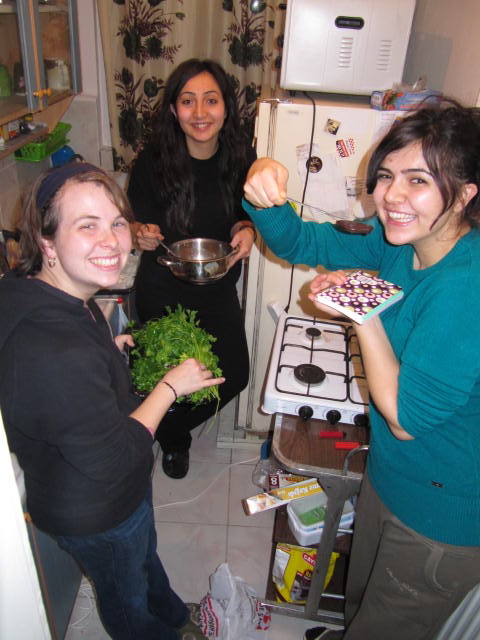

After our adventure around town, we headed back to the house to prepare a big meal with the other couchsurfers. I helped them make all sorts of traditional Turkish food... if only it were something I could make here! We had so much fun cooking this meal! Cooking was half the fun!

This is peynirli börek. It's got layers of flaky pastry bread, and in between the layers, there is yogurt, oil, eggs, baking soda and cheese. And sprinkled on top are sesame seeds. We baked this in the oven for a while until it was golden brown. Quite tasty!


Here is more Cig Kofte, like what I had in Eskisehir. Vegetarian, since they didn't eat meat. We got this at the store and we brought home to make our own wraps with vegetables and these added. So delicious!


After dinner, my hosts serenaded us with some traditional Turkish music played on their Baglama which is a three stringed traditional instrument from the region.


The next morning, I went over to the Anıtkabir, or Ataturk's Mausoleum. The mausoleum is immense and can be seen from any hill around the city. Turkey, and Ankara in particular, has a serious obsession with Ataturk. Throughout Ankara, you can see his effigy hanging from buildings (see first photo of this post) and see his name written here there and everywhere. The obsession is so intense that it is in fact illegal to insult his legacy. The mausoleum, and the adjoining museum are free admission, and probably worth checking out while in Ankara. The museum gives you a good history of modern Turkey plus you can see Ataturk's pajamas, too.


We also made a stop at Haci Bayram Mosque, a mosque dating back to the 15th century. This mosque was built in honor of Hacı Bayram-ı Veli, The founder of the Bayrami sect of Islam and a sufi poet. The style of this mosque was quite different from the grand Blue Mosque in Istanbul or the Kocatepe Mosque in Ankara. It doesn't have the grand domes and high ceilings. In fact, once we found it, we weren't even sure we were at the right place because it was a rather modest looking brick building, or at least modest in comparison to every other mosque I had visited thus far in my trip.


Here is Kocatepe, the biggest mosque in Ankara, and one of the biggest in the world. It can hold up to 100,000 worshipers. Though the style looks old, similar to the Blue Mosque in Istanbul, this is actually a very new mosque, construction was completed in just 1987. The architecture style is called Neo-Ottoman for obvious reasons, but reading the history, it seems that this mosque could have been quite different. There were several different plans for this mosque, dating back to the 1940's. Previous designs were considered too modern and therefore never made it through. Finally, this design was accepted in 1967 and today tourists can enter and see this massive mosque during non-worshiping hours.


The thing I really liked about this mosque was that you could go up stairs to get a better view. This photo was clearly taken from the ground level, but it was also possible to walk up to those balcony levels you can see in the background. These areas are also worship areas as well, and you can easily imagine that 100,000 people could fit into this massive space. 


The last image I'll leave you with from Ankara is the famous İskender kebab. The idea of this kebab is that you take pieces of lamb marinated in tomato sauce, pour it over chunks of hot pita bread, then cover with butter and yogurt. It could be one of the world's most amazing food inventions, and a must try while in Turkey. While this dish is originates from the city of Bursa, I was not able to go to Bursa to try the original, so a reasonable approximation in Ankara had to do. I was quite satisfied with this meal!!

Tuesday, April 10, 2012

Dongdaemun Fabric Market


Even close to my own house, I'm always finding new things that never cease to surprise me. This time it was one of Dongdaemun's giant fabric market in Jongno-6-ga. When Vegging in Chungju asked me where to buy fabric in Seoul, I offered to go with her to find the fabric market in Dongdaemun for a new photo opportunity.


It wasn't hard to find. Along the Cheonggyechong, just past Dongdaemun in Jongno-6-ga the streets are lined with bolts of fabric.


Upon entering the complex, it was like entering another world. Vegging in Chongju was mesmerized by everything and I was seriously overwhelmed. I expected to have lots of fun photo opportunities, but actually this place was full of so much hustle and bustle that it was seriously difficult to stand in one place for a few seconds to properly snap a photo. The photos you see here were just taken at momentary lulls in the commotion.


If you're into sewing or crafting, this is seriously the place to go. Everything seemed pretty reasonably priced, and we even found some remains on sale for really cheap, like 2,000 won/ yard. And, in case you are planning on shopping here, fabric is sold by the yard, not by the meter. While I'm sure some vendors may have been selling in large quantities, all the places we stopped at were more than happy to sell us just one yard at a time.


The size of this market is seriously overwhelming. From the outside, it didn't look so big, but once inside you can easily get lost in the labyrinth of stalls. The vast majority of products here is the fabric, but there are also tailors and seamstresses working here, plus they sell tons of other clothes making materials such as buttons, studs, lace, feathers, beads and so on and so forth.


If you happen to be in the area and are looking for a cool place to check out, this could be it. And if you're actually into making your own clothes or crafts, this is seriously the place to go. This place is basically a fashion designer's dream come true!


To get to the market, go out exit 8 from Dongdaemun Station (not Dongdaemun History and Culture Park) and turn right to walk along the Cheonggyechon stream. The market is inside the building to the right. You can recognize it from the outside from all the fabric for sale. The market is called 동대문종합시장 (General Market/ Dongdaemun Shopping Complex), but you can also ask for the 원단시장 (Fabric Market), and people who work in the area may be able to direct you into the right direction.


View 동대문종합시장 in a larger map

And if any of my readers are interested in meeting for a walk around an interesting place in Seoul for some photo taking, let me know! I'm looking to take more photo walks now that it's spring!

Sunday, April 8, 2012

Play with Culture Cooking Contest at Culcom in Sinchon


Last Saturday, we were invited by a friend to Culture Complex (CulCom) near Sinchon Station, to compete in a cooking competition/ cultural exchange organized by a group called Play with Culture. Of course, the boyfriend, being quite the culinary artist, jumped at the opportunity to prove his skills in the kitchen. So, we found ourselves in CulCom's lounge at 4pm, partnered with other Koreans and foreigners in group #6, preparing to prove our culinary skills.

 
Playing the ladder game to choose a recipe

After finding our group and getting to know each other a little bit, the event organizers explained the rules of the contest. Each team would be randomly assigned a recipe by doing the ladder game. Some forigners were a little confused by this, but eventually we got it all settled and each team was assigned one recipie. We got chap chae. Other teams were assigned Royal Dukbokki, Haemul Pajeon, Dalkdoritang, sujaebi, and sundubu jjigae. We were a little nervous about our chap chae since it is quite hard to make and involves a lot of preparation.

So Mi asking questions, winners get extra money for their team

The next part was getting money to buy ingredients. While each team was given 30,000 won as a base amount to buy ingredients, you could win extra cash for your team by competing in some games. After several attempts, we finally one game... and got a whopping extra 2,000 won.

Next, the participants were given 2 hours to do all the shopping, cook the entire dish and clean up. We all went racing to the supermarket to buy supplies. Our team members wanted to have a dish that was not only pleasant to eat, but also was also visually appealing. With our 32,000 won budget we were able to choose very colorful vegetables like red, yellow peppers (also known as "paprika" in Korea), bell peppers, onions, carrots and spinach. And we bought an expensive (meaning 2,000 won) bottle of makkoli, too, since we still had extra money. And we still had nearly 10,000 won left at the end... what happened to that money?

 
Preparing the Spinach

Very colorful assortment of vegetables

Me, cutting meat with an enormous knife...

A shy team member boiling noodles for the chap chae

Then it was time to go back and cook. We didn't expect it to take so long just to prepare the basic ingredients. Working with limited utensils, cutting boards, pots and pans, it took us the full time to cook our dish. The boyfriend instructed all of us culinarily (is that a word?) inept team members exactly how to cut each of the vegetables, how to marinate the beef, and how to fry the vegetables. But, with his help, we started to make some progress.

Frying vegetables

The final stir

Chap Chae, the noodles themselves, need to be fried together with all the veggies and soy sauce once everything is prepared. Having one, medium sized frying pan was certainly a challenge, but the boyfriend skillfully alternated frying one half at a time until it was perfect. As we were tasting it before it was done frying, we started to have our doubts about our work. It was too salty... it was tasteless... we started eying the other group's work wondering if it would be possible to win. But, once we were done frying everything and we gave it one last stir.... we realized it was perfect. There was no way we could lose the contest.


Introducing the judging part of the competition

 
Sample cups for passersby to taste

In order to avoid bias from judging within our own members, each team prepared small sample cups to bring outside for passersby to taste. While the group organizers took everything to the streets, we stayed in, tasting a little bit of everyone's food. Some groups were better than others... some were completely indistinguishable from what they were supposed to be making (that's not to say they didn't taste good... but...) but other groups had done pretty darn well. We started to get a little worried. But, the free makkoli that started coming out from the back room made us quickly forget that.

 
Group #6, the winners!

Celebrating victory with a box of Manoffins

After about 20 minutes, the organizers came back from the streets with the results from the taste tests. And who do you think won? Of course, team #6, our amazing team lead by my amazing chef. We were presented with our grand prize... a box of 6 muffins from Manoffin. Well, the prize wasn't much to show, but we had the glory of knowing we were the best chefs in the room.

Immortalizing the prize winning chap chae

The Recipe: 
1 package of fresh spinach
1 medium sized carrot
1 onion
1 red pepper
1 yellow pepper 
1 green pepper
1 package of mushrooms
100g of beef
1 bag of sweet potato glass noodles
soy sauce
sesame seed oil
sesame seeds
cooking oil (vegetable oil, grape seed oil, etc)
(other vegetables as desired)

Cut all vegetables and meat into thin medium sized strips. Put the meat in a marinade of soy sauce (add oyster sauce to the marinade for extra goodness). Saute the mushrooms in soy sauce for several minutes. Boil the spinach for a few minutes. Add a little soy sauce and sesame seed oil to the boiled spinach to taste. Fry onion, peppers, and carrot together in a frying pan with a little soy sauce. Fry marinated beef separately. Boil the noodles until soft. Wash and rinse noodles thoroughly under cold water for several minutes. In a bowl, add cooking oil to the noodles and mix thoroughly. Fry noodles in a frying pan with soy sauce, to taste. Fry for several minutes, but don't allow the noodles to burn. Remove from heat and add the fried vegetables, meat, spinach and mushrooms to the noodles. Mix. Add more soy sauce if needed, add some sesame seed oil to taste and sprinkle sesame seeds on top. Enjoy! 

Not hard, but it is a little time intensive! Good luck! If you try this recipe, blog about it and leave a link here! 

For more events run by Culture Complex, join their facebook page: https://www.facebook.com/culcom?ref=ts&__adt=3&__att=iframe

The ad which got us interested in the event:


And the official video from the event:

Friday, April 6, 2012

Backstreets of Insadong and Wonderful Hanjeongsik


One of Seoul's top tourist destinations is a little street near Jongno called Insadong. Nearly every tourist to Seoul makes at least one stop here during their trip. While tourists usually spend their time on the main street discovering art shops, souvenir shops, art galleries and tea shops, I have discovered that Insadong's back alleys are really where it's at. Sneaking down some of the barely noticeable side alleys will bring you to some quite unexpected surprises.


One day I decided to take a trip around the snaking back alleys to see what I could find. There were lots of little, hidden restaurants and interesting looking pubs that were still closed since it was daytime.

Daesong Hanjeongsik Restaurant

The second time I went, I took the boyfriend with me and we decided to find a restaurant to eat lunch at back here somewhere. We settled on this Hanjeongsik restaurant. Hanjeongsik is a traditional style Korean meal which consists mainly of many small side dishes (panchan) and a few bigger dishes like jjigae, fish or meat to accompany them. Hanjeongsik tends to be quite expensive, but at this restaurant, the price was just 10,000 won per person for lunch. Take a look at some of what we had:

 Sigeumchi Namul

Sigeumchi Namul, or spinach in English, is one of the most common side dishes you can see in Korea after kimchi and radish. This is one of my favorites. It's served cold or at room temperature and after it is boiled down, it is seasoned with a little soy sauce, garlic and a touch of sesame oil and sesame seeds.

Baek Kimchi

Baek Kimichi, or white kimchi is less common than the normal, spicy kimchi, but it is another popular side dish, especially with hanjeongsik. Though it is made with cabbage, much like the kimchi we all know and love, it is not spicy at all. It is made with salt, garlic, ginger, and often times some pear juice as well.

Biji in a stone pot, with other side dishes including onions, anchovies and cucumber

Biji is not too common to see in Korean restaurants, but it is a super healthy food. It's made from the insoluble parts of the soybean after tofu is made. Therefore, it's really high in fiber and protein. The consistency is kind of similar to cream of wheat, which we often eat in America. On it's own, it doesn't have much taste, but together with the rest of the side dishes, it's lovely.

Pajeon and boiled pork to the right

Pajeon is a scallion pancake. The bowl in the middle is full of soy sauce for dipping. The fat of the boiled pork might be off putting to some foreigners, but I was pleasantly surprised when I bit in. It was super soft and tasted marvelous. You can also dip it in the sewoojeot, or sauce made from tiny shrimp for extra flavor.

 Doenjang jjigae with rice with garlic cloves

And what Korean meal would be complete without some jjigae? Doengjang jjigae is a stew made from a bean paste. It's full of tofu, zucchini, onions among other vegetables as well. 


Next time you're in Insadong, be sure to head down some back alleys to find Insadong's greatest treasures! 

Wednesday, April 4, 2012

Tower Condo and Spring Skiing


On Saturday, March 24th, we hopped in the car after work and drove up to Yongpyong, our usual winter destination. While Seoul at that time was starting to feel slightly warmer, Hoenggye, the town at the base of Yongpyeong still had plenty of snow to be had. Another storm had just dropped more snow in the area the day before and we were looking forward to an amazing day of skiing on Sunday.

Kitchen in Tower Condo

When the ski season is still in full swing, booking condos at the resort can be difficult. And expensive of course. Fortunately, we (ahm, aka the boyfriend) bought a condo membership this year, so a night at any of the condos around the resort starts at 70,000 a night instead of around 200,000 per night. So, that took care of the cost. Booking, especially last minute tends to be difficult, but since it was the end of the year we were able to call on the way there and get a room in Tower Condo.

Tower Condo

As the olympics are coming in the next few years, I've been trying to document every place to stay around Yongpyong. So, here's what a basic room in Tower Condo looks like. This is, of course, an ondol room which means there's no bed, just floor mats. Nowadays I sleep on the floor more often than in my own bed so this is nothing strange to me.

Tower Condo

There is a small kitchen with an electric stove with two burners. Unfortunately the sink was seriously blocked which made cooking our spagetti dinner a little difficult.

Bathroom in Tower Condo

The bathroom was nice. No tub in this condo, but it had a nice big shower stall. To see other Yongpyong accomodations, along with other info about Yongpyong, click here.


And as for the skiing? It was great, of course, just like it was at this time last year. Spring skiing in Yongpyeong is usually great! We skied the whole day in beautiful powdery conditions.

Monday, April 2, 2012

Korea Blog WKB Welcoming Event, 3/23/2012

Jessica Steele, author of ROKin' Around Korea being interviewed by Arirang News

As you may know, I'm one of the "Worldwide Korea Bloggers" for The Korea Blog. The nice thing about blogging for the Korea Blog is the opportunity to take parts in various cultural events around Korea. I've been invited on many trips, including a trip to Jeju last year, but it seems I only ever have time to fit in the actual welcoming ceremonies that they hold each year due to my work schedule. On March 25th, they held a welcoming ceremony for the second batch of bloggers. Now there are 50 bloggers in Korea and around the world who contribute to this blog. When I walked in, I was a bit surprised to see Arirang News there on hand to document the event. You can see the whole press release here, including a video featuring an interview with me!

Asif Quadri, author of Adventures in Daegu and Beyond, who I met last year as well. 

We were asked to introduce ourselves and our blogs, all while being filmed by Arirang AND the Qi Ranger. Needless to say, I don't think I'll ever be able to be a celebrity. I lose what little ability I have to speak articulately once the camera is on me. Probably for the best, I suppose.

We even made the English Language Newspapers, page 20 of the Korea Herald on March 26th.

After the event at the KCOIS office, we hopped in a bus and headed over to the National Museum of Korea for a guided tour and an art lesson.


Anyone who wanted to film in the museum needed a press pass. I didn't want to film, but I just wanted to look special wearing one...


It was somewhere around this crown that I was interviewed. I kind of wanted to hear what the tour guide was saying, but I guess Arirang is more important..


I learned a bit more about Buddha statues from this tour, and I hope to blog on the topic more... if I ever have time to blog again, that is...


The last activity of the day was a painting activity. As this is the year of the dragon, we were taught how to paint a dragon. Actually, it mostly involved tracing, but I'll pretend that we're all really good artists for the sake of the blog. Mine came out pretty good, but unfortunately I was in a rush to get back to work for the night shift so I didn't really get to finish it properly.


You can learn more about the event from the Korea.net press release here, and see my blog posts from last year's event here and here. If you like the sound of becoming a blogger for the Korea blog, they'll probably be accepting more bloggers next year. It's a great opportunity and has inspired me to get out more and find exciting events to blog about. Now if only I had time to write....