Wednesday, January 16, 2013

Foods of PyeongChang: NamKyeong Sikdang (남경식당)


Just on the outskirts of Hoenggye, the town at the base of Yongpyong resort, lies one of the area's most famous restaurants: 남경식당 (Namkyung Restaurant). The restaurant is not too big (though you can see it was extended a lot from it's original size), but when we arrived, the parking lot was full. We were lucky to get a seat since one group left just before we arrived, otherwise we would have been waiting for a table... something I can't remember the last time I did...


The restaurant is famous for three dishes: 꿩만두국 (pheasant dumplings), 막국수 (Makguksu) and 수육 (suyuk). We ordered one  꿩만두국 and one 막국수 to split between the two of us. Apparently, suyuk is their most famous dish, but since it was lunch time, we didn't see anyone eating it.


There's something really exciting about eating pheasant. I'm not sure what it is, I think it's the feeling that you're eating something that the elite would eat... or at least it sounds that way in my mind. In fact, pheasant was the meat of choice to fill dumplings many years ago, but due to overhunting people had to start settling for chicken, coining the 속담 (expression):  꿩 대신 닭  (Chicken instead of pheasant), meaning that you have to settle for second best. A useful expression for those studying for the TOPIK exam :-).


Actually, I couldn't really taste anything different. But I like being able to say that I ate pheasant for lunch. However, the broth on the other hand was the best manduguk broth I've ever had. That is partially because I'm generally extremely dissatisfied with manduguk broth in general, but I can still say, without comparing it to other manduguks in the past, that it was a pretty decent broth which actually contained some flavor that was neither hot pepper powder nor black pepper.


Next was the Makguksu. Makguksu is kind of like bibim naengmyeon, but made with buckwheat (soba) noodles (메밀) rather than potato or sweet potato noodles.  See how all the ingredients are piled, relatively neatly on top of the noodles? Yea, don't eat it like that, mix it up!


 This was also very nice. I like makguksu better than naengmyon because the noodles aren't so chewy.


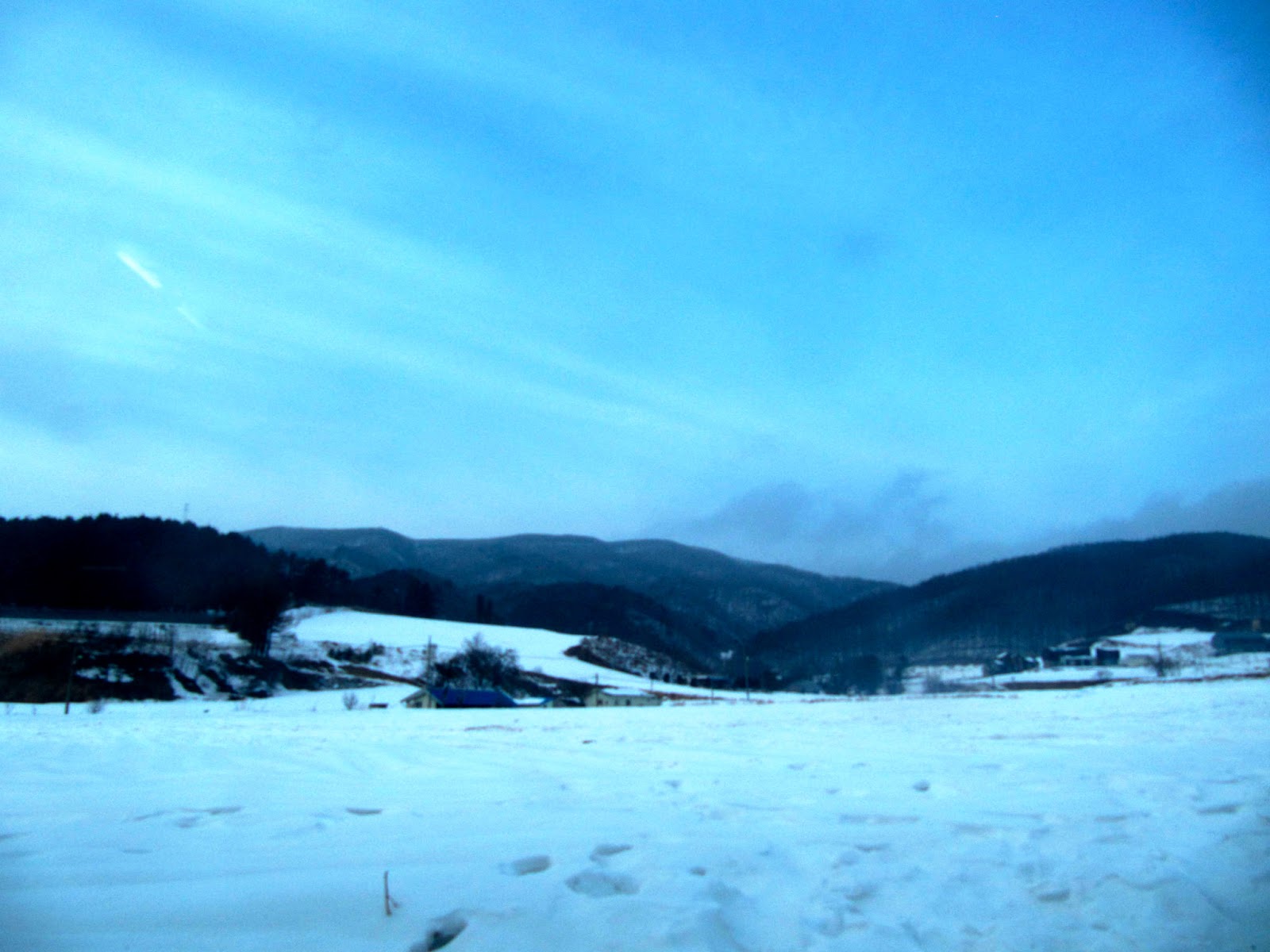
The restaurant is owned by a somewhat famous local Korean skiier named Kim Hak Rae, however, I think the food is what keeps the people coming in, not the famous name. As we were leaving a bus load of hikers arrived to have some makguksu of their own. As you eat here, be sure to get a seat by the window to enjoy the nice winter scenes right outside the window!
 강원도 평창군
대관령면
횡계3리 21-5번지
(033) 335-5891

Hoenggye-3-ri 21-5
Daegwallyong-myon
Pyeongchang-gun
Gangwon-do, South Korea
(033) 335-5891


View 남경식당 in a larger map

Monday, January 14, 2013

Homemade Mi Yeok Guk (미역국)

Mi yeok guk (미여국) is a soup made from a particular seaweed, Undaria pinnatifida, also known as 'sea mustard' in English. Others may know this seaweed by its Japanese name 'wakame'. Mi yeok guk is the most famous food eaten during pregnancy in Korea. Because of it's high iron, calcium and protein, many pregnant mothers-to-be and new mothers eat a lot of this soup to keep up their strength. To remember their pregnancy and new motherhood, mothers traditionally make this soup for their children every year on their birthday.
 
Tomorrow happens to be my boyfriend's birthday, and, while not getting a cake might be forgiven, not having mi yeok guk to eat for breakfast on one's birthday would be a sin here in Korea. So, finally, for the first time, I went ahead and tried making mi yeok guk on my own as a surprise. 


The two most important ingredients you'll want to have on hand are mi yeok (미역) and sesame oil (참기름). All the other flavors you can play around with, but these two are essential to getting it right. 


You don't need much mi yeok, in fact, just a small handful is enough to make several cups, which will make a soup to feed 4-6 people. The first step is to soak your mi yeok in water for about 10 minutes so that it absorbs water. Your small handful will expand into much more than what you started with!


I went with a beef base, so while the mi yeok was soaking, I started frying the beef in the pot with some sesame oil. 


Most people don't use onions, but I found a few Korean bloggers that used onion (양파), and since I had quite a few on had, I decided to throw in one, small onion.  I fried them up together with the beef and garlic and it was starting to smell quite nice.


By that time, the mi yeok was all ready. Since the mi yeok comes in very long pieces, I used some scissors to cut it up in to smaller, bite size pieces. Using a knife would also be helpful here if you cut up the mi yeok on the cutting board.  


Add the mi yeok to the beef and fry for several minutes, stirring constantly to keep it from burning. 


Next, it's time to add the water. I didn't measure exactly, but I would say that I added about 8 cups of water. Use your best judgement. You need a good ratio of mi yeok to broth. Then it's time to add your flavors. Some soy sauce (간장), salt (소금), anchovy powder (멸치 가루) are all good options, and can be adjusted to your personal taste. Then let it boil for a while 1-3 hours, the longer the better.

Recipe: 

1 oz. (about 30 g) mi yeok (seaweed) (about one small handful)
1 lb. (about 500 g) beef*
1 small onion*
1-3 Tbs sesame oil
3 cloves of minced garlic
8 cups water
2 Tbs soy sauce
2 Tbs salt
2 Tbs anchovy powder **

*optional
** can be replaced with other seasoning

Fry meat, garlic and onion with sesame oil in the pot which you will boil your soup in. Soak mi yeok in water for 5-15 minutes, until mi yeok has expanded. Fry mi yeok with beef (you can add extra sesame oil for flavor) for 1-3 minutes. Add 8 cups of water (or an appropriate amount with a good ratio of mi yeok to broth). Add soy sauce, salt, and anchovy powder or seasoning to taste. Boil for 1-3 hours, the longer, the better. Taste the broth and add more flavoring as desired.

Free Korean Classes at the Seoul Global Center

From the Seoul Global Center

Korean language course at the Seoul Global Center
The Seoul Global Center (SGC) will open its 1st term of 2013 of free Korean classes as follows:

1.  Course Outline
Course duration: Monday February 4th ~ Friday April 26th, 2013 (12 weeks)
Classroom: Conference room in SGC
Eligibility: International Residents in Seoul(This program is designed for adults)
Fees: Free of charge(The textbook should be purchased by students)
Class schedule
Level
Class days
Time
Level Description
Basic
Tue. /
Thur.
12:00~
13:30
You will start with the Korean alphabet.
Lower
 Beginner 1
Mon. /
Wed.
10:00~
11:30
You already understand how to read, speak and can make very basic present tense sentences. You can introduce yourself and make greetings. You understand the grammar of: 입니다/입니까?’, ()ㅂ니다/()ㅂ니까?, ‘/, /’, / and commands.
Lower
Beginner 2
Mon. /
Wed.
19:00~
20:30
You already understand the following grammar: noun+/ 아니다, noun+예요/이에요, verb+/어요, ~, ~에서, and Sino-Korean numeral
Upper
Beginner 1
Mon. /
Wed.
19:00~
20:30
You can ask and answer about dates, days, time and price and you can order foods and buy things. You understand the grammar of: ‘(), ‘탈락동사, ‘()십시오
Upper
Beginner 2
Tue. /
Thur.
10:00~
11:30
You can make orders over the phone. You understand the grammar of: honorifics, unit nouns, / 주다, 말다’, ㅡ탈락 동사, ㄹ탈락동사, ()ㄹ거예요, /어주다, 말다’, ‘-한테()/에게(), ‘-’, ‘-/’, ‘’ irregular verb, vocabularies about weather and you can describe character, things and you can compare between two things.
Pre
Intermediate
Tue. /
Thur.
19:00~
20:30
You understand the grammar of: ‘-()’’, ‘-부터/까지’, ‘-지만’, ‘-()러 가다/오다/다니다’, ‘’ irregular verb, negative expressions, explaining reason, vocabularies about hospital related words & symptoms
Intermediate 1
Mon. /
Wed.
12:00~
13:30
You understand the grammar of: ‘-()(past tense)’, ‘-()(future tense)’, ‘’ irregular verb, ‘’ irregular verb, ‘-/어 보다’, ‘-다가’, ‘-()’, ‘-/어야 되다/하다asking for/giving directions, vocabularies about traffic related
Intermediate 2
Tue. /
Thur.
19:00~
20:30
You understand the grammar of: 느라고, () , (), 되다, / 지다, 다면, / 가다, 반말, / 보이다, ()면서, 보다, 자마자, 바람에, / 놓다, /어도, 더라, 나요’.
TOPIK Prep.
Intermediate
Friday
10:00~
11:30
You should have finished intermediate courses (The course of level 3 or 4).

2.  How to Apply
Application period: Wednesday January 16th ~ Thursday January 17th, 2013
-          Office hour: 9am ~ 6pm / Lunch break: 12pm~1pm Please be advised that we accept registration only during the sign-up period.
Application procedure: Actual applicants must visit SGC in person and fill out the form
Online or proxy application is not acceptable.
Application requirements
      - Alien Registration Card
      - A copy of applicant’s color photo (size: 3*4cm)
Admission: First-come, First-served basis

3.       Class size: between 12 and 15 studentsIf classes are all full before the application period is over, the applicants can be put on a waiting list if they would like. If there are drop-outs within the first two weeks, these spots will be filled with people from the waiting list in the order they signed up.
Please be advised that there will not be a waiting list for basic course participants.


4.       For more information, please contact
    Phone: (02) 2075~4180
    Email: hsahn3003@gmail.com
    Webiste: http://global.seoul.go.kr
   ㅇ Location: Seoul Global Center, 3rd floor of the Korea Press Center
                 (Exit 4-Press Center direction, City hall station, subway Line 1 or 2 / Exit 5, Gwanghwamun station, subway line 5)