Monday, June 4, 2012

Hanji Home Decorating


For the past two years I've been eating off of this rather pathetic table that was in our apartment when we moved in. Actually, the size was perfect, which is why we used it, but it had some sort of paint on it that absorbed every spill, and so after 1 month of using it, it was no longer presentable because of all the odd colored stains on it. From that time on we've always kept it covered with table cloths and it's been our faithful dinner table and been the center of many parties over the years.

As we've been preparing (mostly mentally more than physically) to move to our new hanok house in early June, I keep imagining where I'll put what in my new house, but this table never seemed to fit in in my imagination... A low table with a table cloth just doesn't fit into the house in my imagination... it's just to ugly and awkward for (what I hope will be) our amazing new house.

But then one day an idea struck me. I had seen some cool photos in some magazines, and what if I cut them out into a collage and then lacquered over it to make a shiny, waterproof table that I could use in my new house? Seemed like a great idea and so I went about furiously cutting out magazine pictures and spent a few hours rearranging and filling in gaps with filler photos and things and finally I had a collage.... but the border was the problem... I decided I needed some kind of border around the edge an for some reason thought of hanji (한지), Korean handmade paper. I went over to a hanji store in near Jogyesa in the Jongno area of Seoul and picked up 5 pieces of hanji paper with a print that was a mixture of Chinese characters and hangeul. It was super cheap, just 1,000 won per sheet.


The original concept.... 

I got home and put down my hanji border onto my table first... and then I realized that I rather liked the hanji... and that my artistic ability to make a good collage were lacking... so I just scrapped my hours of work arranging photos and just did the whole thing in hanji.

Just did the border at first....

But, then just kept going... 

Then we had to do the most important part, making it waterproof. The boyfriend went to the paint store and the man there told him the best way would be to use water lacquer. We took it outside to lacquer it up, but we realized that modern water lacquer, unlike it's predecessors has very little fumes because of it's water base. So, after 2 coats, we brought it back in the house. We still weren't convinced that two layers of lacquer would be enough to make it waterproof, so we continued on to make about 6 layers. But, now it seems to be good.

Water based laquer

The boyfriend, lacquering the table, maybe on the 4 or 5th coat.

But, that's not all.... Then we were sitting in our kitchen 2 weeks later and we were looking at what was our microwave stand, that will be our shoe holder in the new house. We picked it up for free a few months ago from a guy in Haebangchong and we almost didn't take it because... well, it was rather ugly. The more we stared at it, we realized that it wasn't naturally ugly, someone had covered it with a really ugly flower print sticker (what Koreans call situji 시트지).  We peeled it off, but a layer of stickiness was left on the cabinet... so... what to do? Just stick hanji on it! Since we won't be eating off it, we don't need to lacquer it, so we were able to do it super quickly. Looks great, right?


So you want to decorate with hanji too? it's quite easy, all you need is some hanji from your local hanji retailer (I recommend Jonggak, or Bangsan Market near Eulchiro-4-ga station, though there are many hanji shops in Insadong, too), glue (we used just flour and water, boiled), and a sharp box cutter to cut any edges. Paste and cut away!

 In our new hanok!

ps. Stay tuned for episode 2 where we hang hanji wallpaper in our new house!

Friday, June 1, 2012

Yeoju Ssalbap 여주 쌀밥


While we were in Yeoju, we thought we should try Yeoju's specialty, Ssalbap 쌀밥. Upon asking what that meant, we realized that it was Ssal (uncooked white rice) and bap (cooked rice). So... Yeoju's specialty is rice-rice? Yup, pretty much. Yeoju and the region around Yeoju, including Ichon, is famous for it's rice. The best way to enjoy Ssalbap is to order Ssalbap Jeongshik 쌀밥 정식. Ordering jeongsik means getting a huge meal of various side dishes, many of which can be refilled if you eat it all. Here are some of our side dishes first.


Dubu Kim Chi 두부 김치 (Kim chi and Tofu), one of the most delicious side dishes or anju in Korea. The mix of cool tofu and spicy kim chi is the perfect combination.


Dotori Muk 도토리 묵 - A jelly like side dish made of acorns. As it has little flavor on it's own, it's been seasoned here with scallions, sesame seeds and soy sauce.


Dotori Jeon 도토리 전- a pancake made with acorn flour. In the middle, a piece of suk in the middle.


Doengjang paste 된장 with vegetables- Dip any green leafy veggies you like into this bean paste.


Doengjang jjigae 된장 찌재 f Korea's standard stews. It's broth is made with fermented bean paste, and usually you can find various vegetables inside like zucchini and onions. And of course, you must have some tofu.


But, really, the main point of Ssalbap Jeongsik is the Ssalbap. It is generally served in a hot stone bowl for maximum enjoyment. It took a little while to prepare as the stone bowl must be heated to a very high temperature. Finally it came to us. The yellow on top is called jopssal 좁쌀, it's a small yellow grain, and the brown is a red bean. After getting the stone bowl full of rice, the first thing you should do is remove all the rice right away. There will be a layer of rice stuck to the bottom, don't worry about that, that's the best part.


Next fill the stone bowl with hot water and wait for the water to boil. It will boil within a minute or so.


Then let cool, stir and enjoy!


Next time you stop by Yeoju or Icheon in your travels around Korea, be sure to stop and have some Ssalbap!

Thursday, May 31, 2012

Bike trip from Yangsuri to Yeoju


With the Buddha's Birthday holiday weekend fast approaching, we had to think of something exciting to do. We finally settled on a trip from Yangsuri to Chungju. We calculated the trip to be approximately 110km. We had done 60 km without too much trouble from Yangsuri to our house in Seoul and figured, another 50 km wouldn't be so bad.


We set off from Yangsu station, about an hour outside of Seoul on the Jungang line, at 10 am. A later start than we had hoped for, but it was the best we could do given that the Jungang line only runs every half an hour or so as far as Yangsuri and we wanted to eat breakfast before hitting the road.


From Yangsuri to Yangpyeong, it's about 15 km, or about an hour ride. The scenery is fantastic here, at certain points you literally ride your bike through rice paddies as you can see above. This is my second time on this course and it just gets lovelier each time. You kind of get the feeling sometimes that you're no longer in Seoul, but in Southeast Asia. It's easy to forget that Korea is not all apartment complexes and cell phone stores when you're living in a city.

After arriving in Yangpyeong around 11 am, we were starting to feel a little depressed when we saw the sign for Chungju Dam, 96km. But, we continued on bravely, following the signs for the Namhangang bicycle path and for Chungju Dam.


The path after Yangpyeong was a little different. It hugged tightly to the river and we passed through some beautiful wetlands with views of white cranes and tree lined paths.


Then our path veered sharply off the riverside bike path and on to a (carless) road, straight up hill for about 10 minutes. I gave up after a 5 minute struggle, but the boyfriend and my friend struggled on courageously all the way to the top.


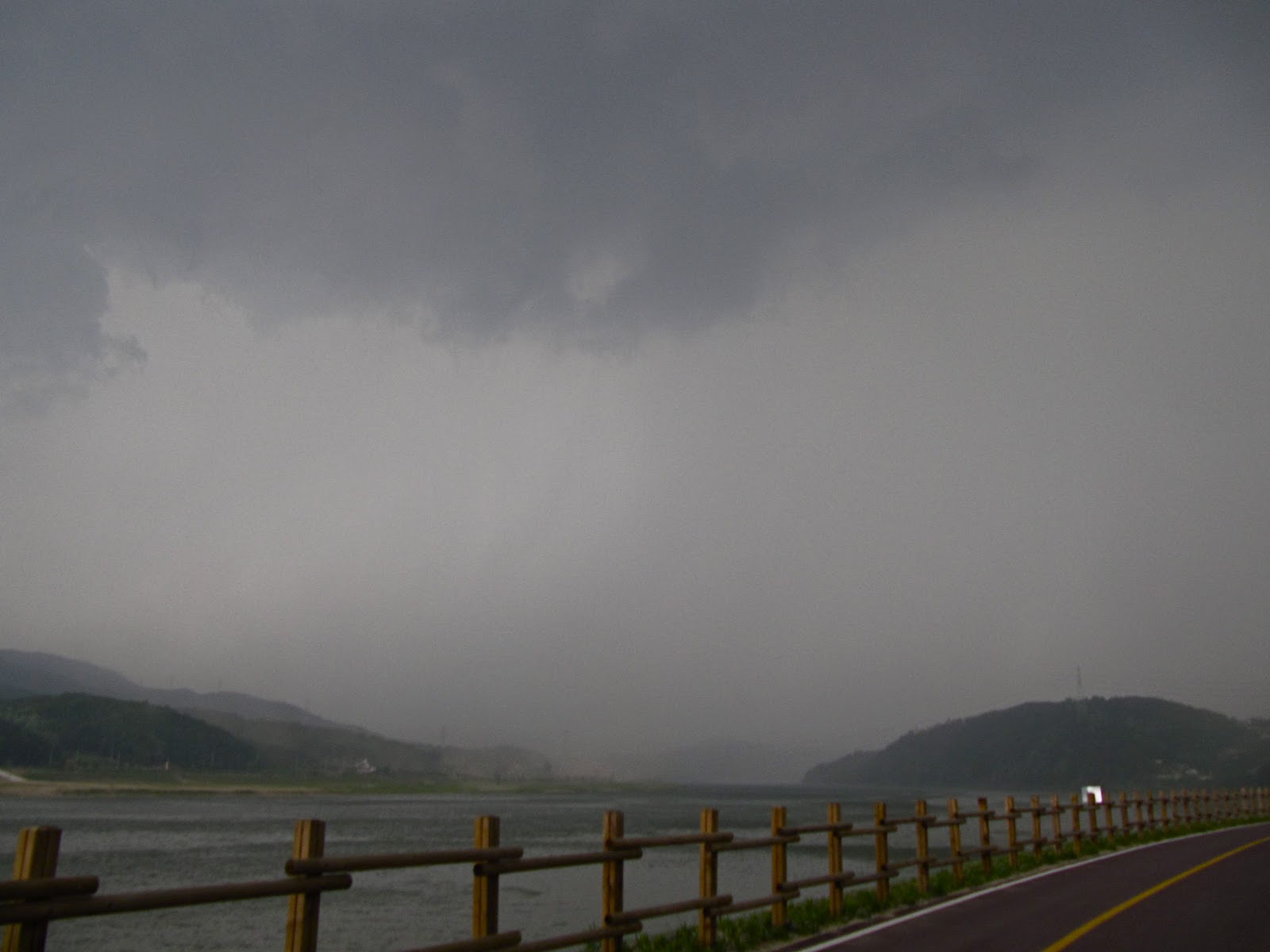
While resting at the top of the hill we started to hear the rumble of thunder in the distance and we started to think that we should start looking for a small restaurant to take some shelter. Though, strangely, while there are always small makkoli houses along the bike path when we don't need them, now that we could hear thunder in the distance, we couldn't find a single one. With the trees on all sides I wasn't too worried, though I wasn't looking forward to getting wet... but as we came down to the bottom of the hill and found our bike path again, we discovered that we were back along the river, and not just any part of the river, but a part of the river where every tree had been torn down for some kind of construction project. The winds were starting to whip and we could now see real bolts of lighting in the not-so-far-off distance. I was getting a little freaked out, and we decided we had to find somewhere... anywhere... and asap. With the wind at our backs and the storm fast approaching we flew at the speed of light down the bike path. If only we could ride that fast the whole way... we'd be in Chungju in no time... And then, just as the raindrops started to fall, a small makkoli tent serendipitously appeared. We left the bikes where we could and ran for cover just as the serious winds and torrential downpour started.


From the tent window, we watched the tarp outside being blown in sideways from the wind, but our tent was sturdily built into the ground. We were safe and we decided to make the best of our break time and order some pancake and makkoli.


Fortunately, the storm blew over quickly and by the time we were done with our pancake the storm had completely passed over. We hopped back on the bikes, which were a little wetter and muddier than when we had left them, and continued along the path.


We reached Ipobo not long after and we found an information desk on the bo which gave us some bike maps and told us which way to go. The woman informed us that we should expect to go another 5 hours to reach Chungju. Our tushies were starting to hurt a little bit by this point, and we had kind of lost our groove, so to speak, after the thunderstorm and the snack. But, we continued on again.

The road from Ipobo to Gangchonbo wasn't long, but it felt it. We all got separated for a while, all going at different speeds. The wind was no longer at our backs now, but hitting us head on, making it a little Once we reached Gangchonbo we were able to see Yeoju, our next stopping point, in the distance and we were again inspired to pedal harder to reach the where we had planned to eat lunch. Apparently, according to our GPS, it was 7 km and 35 miniutes from Gangcheonbo to Yeoju, but honestly we thought it was only 10 minutes and 2 km it went so quickly. It's strange how being able to see the destination clearly makes such a difference on time perception...


We were quite happy to get off our bikes for a while and eat our lunch. As we sat eating, we started to realize that now at 3 o'clock, getting to Chungju might be a bigger challenge than we signed up for. Our bums were hurting (we haven't ridden for 2 weeks) and we were feeling a little worn out. But, the last time I was in Yeosu, I felt that there was enough to do/see in this little city that I thought I would like to come back. I guess now was as good as time as any to explore Yeoju. We decided to stay there and see the town. More on Yeoju in the coming days, but you can already see our Monday activity at Silleuksa on Buddah's Birthday here.


I haven't given up my grand biking dreams. Someday I will make it to Chungju... or another distant place that happens to lie on a bike path. If you would like to make your way to Yeoju or Chungju, or even just Yangsuri or Yangpyeong, look for signs like this one above. The 남한강 자전거길Namhangang (South Han River) Bike path starts in Yangsuri and goes all the way to Chungju, almost completely on well maintained bike paths. Just follow the signs for Chungju Dam! 

Monday, May 28, 2012

Buddha's Birthday at Silleuksa, Yeoju

 Outside the entrance to Silleuksa

This year for Buddha's Birthday, we found ourselves at Silleuksa (신륵사) temple again. This is our second time to visit this famous temple in Yeoju and it turned out to be a great place to celebrate the holiday. There were tons of people and tons of activities to be do and sights to be seen. 

 Pouring water over Buddha's head

First thing first we headed into the temple to look around. it was quite different than our last visit, 3 months ago. Last time we were here, there were no leaves on the trees, not many people to be found and not nearly as many lanterns to be had. This time it was the opposite. Beautiful scenery, packed with people and of course full of lanterns.

Hanging messages on the lanterns

Silleuksa is a rather special temple because, not only is it ancient dating back to the Silla dynasty, but it is also one of the few temples in Korea that was built along a river rather than in a mountain. It's fame brings a lot of visitors to this particular temple, hence the number of events happening this Buddha's Birthday.


Loads of people were enjoying the riverfront views from the temple. Folks on the other side of the river seemed to be enjoying the water itself. The river was filled with swan boats and one speed boat zooming around giving the swan boats some exciting waves.

A view of the Namhangang (South Han River) alongside Silleuksa

 Temple volunteers preparing our bibimbap lunch 

And, of course, perhaps the best part of Buddha's Birthday is the free temple food. Guaranteed to be 100% vegetarian. We were served bibimbap with big pieces of ddeok (rice cake).

Bibim-ing our bap

Hanja woodblock prints

Making a Dalma woodblock print 

After we had our fill of food and temples, we headed out to do some of the activities outside the temple grounds. There were plenty of activities and crafts to try, but I just tried two, a block print of Dalma (also known as Bodhidharma , the monk who brought Buddhism to China) and, of course, a lotus lantern.
 Me and Dalma

 Lotus lantern pro... 

Lanterns are the most typical craft around Buddha's Birthday and it wasn't just for kids either. Young and old all gathered around the lantern making table to make their own lotus lantern. 

Me and my lotus lantern

How did you spend your Buddha's Birthday? Be sure to spend your next Buddha's Birthday at your nearest temple to make the most of this holiday!

Friday, May 25, 2012

My Janggu Concert


Last week we finally held our much anticipated janggu concert. After just 6 weeks of studying the janggu (8 classes in total) we were put on the stage to show off what we had learned. We were really worried because we hadn't practiced in a week, and even our rehearsal before the show wasn't so great, this was to be our first time performing without the music notes on the board in front of us.

Our teacher, Mr. Oh, performing on the kkwaenggwari

Fortunately, we were the last of the three performances scheduled for the day. The first performance of the afternoon was a professional Samulnori group, lead by our teacher, Mr. Oh. Watching this performance after 6 weeks of studying the janggu was like a whole new experience for me. While to the untrained ear, the music of samulnori can just sound like a jumble of unorganized sounds, but after studying the rhythms in our janggu class I was able to pick out various rhythms that they were playing.


After the professional performers cleared the stage, it was time for the second performance of the day, a group of foreign students from Hanyang University performed Samulnori playing the janggu and the buk (a smaller round drum which is beaten with a thicker drumstick).  We all really enjoyed watching them playing the buk, waving their arms around whenever they weren't hitting the drum...

Hanyang University students performing Samulnori


Finally, it was the moment we had been waiting for. We all filed on stage. Two students introduced themselves and thanked our teacher and the staff for making the class possible. Then, we got settled and our teacher banged on the kkwaenggwari (mini brass gong) and we started our performance.


If you're curious how we did, just check the video. But, I can say, our final performance was much, much better than our rehearsals. We finally pulled it all together in the end!


 Thanks to the staff of the Korean National Folk Museum for providing this free class to us. I hope I get another chance to study the janggu, it was such a fun experience!