Thursday, November 11, 2010

Jeju Guide: Gates of Jeju


There are three things that, legend has it, don't exist on Jeju; thieves, beggars and gates. They say that Jeju was traditionally such a hard place to survive that everyone worked together for the common good that thieves and beggars were non-existent. And, of course, if there are no thieves or beggars, there's hardly reason do have a gate to keep people out, right? And Jeju's gates are quite unique and meaningful, so I thought they deserved a post of their own. You may have noticed already that the distinguishing feature of the Jeju gate are the three poles which cross the entryway. They are hardly going to stop someone from entering, but as there are no thieves that would never be a problem, of course.


When all three poles are removed from their vertical position, it means that the owner is home and all are welcome to enter.


When one pole is laid across as such, it means that the owner has stepped out, but is in the area and will be home soon.


Two poles across the entry way mean that the owner has gone and won't be back for a few hours, but should be back before the end of the day.

 
Finally, three poles across means that the owner has left town or doesn't expect to be home for a few days. This one seems to me to be a flag saying "rob me!", kind of like those people on Facebook who get their homes robbed after saying "I'll be gone for the next 5 hours" while posting their address on their profile. But, of course, there aren't any thieves in Jeju so I guess it's never been an issue for them.

These lovely photos were taken in Songup Minsokmaul 성읍 민속마을. I will post more on this village soon. I'm finally coming to the end of my adventures in Jeju, there's only a few posts left to write!

Wednesday, November 10, 2010

Adventures in yogurt and natto making


I find myself eating a lot of yogurt lately and the cost was starting to add up. If you want to buy unsweetened plain yogurt, it's about 2,000 won for 4 servings. The price isn't outrageous, but if you plan on eating 1-2 per day it adds up. I wasn't too bothered about the price to be honest, actually, but my boyfriend found a yogurt maker online for about 18,000 won on G-Market and thought we should give it a try.
The yogurt maker has become our new obsession. We make a new batch every few days. It's quite easy if you've never made it. Actually, you don't really need a "yogurt maker" per se, to make yogurt, all a yogurt maker does is keep your milk at a steady temperature so that the yogurt culture can grow and multiply.  Just (sterilely) add some pre-made yogurt with active cultures into a carton of milk and let it sit around 41-49˚C It only takes about 8 hours to turn milk into yogurt but we leave it in for up to 24 hours to get the strongest taste.


Some websites will show you very complicated ways of making it, raising the temperature of the milk, lowering the temperature of the milk, using thermometers and all sorts of things, which you would probably need if you didn't have a yogurt maker I guess. But with this simple machine a carton of milk fits perfectly inside and keeps it at a constant temperature which makes all that extra stuff unnecessary.

We've experimented with a few flavors for the yogurt. The best is the 복분자, popunja which is a raspberry extract. While most people know 복분자 as alcohol, that's just another form (and a dangerous one at that...)

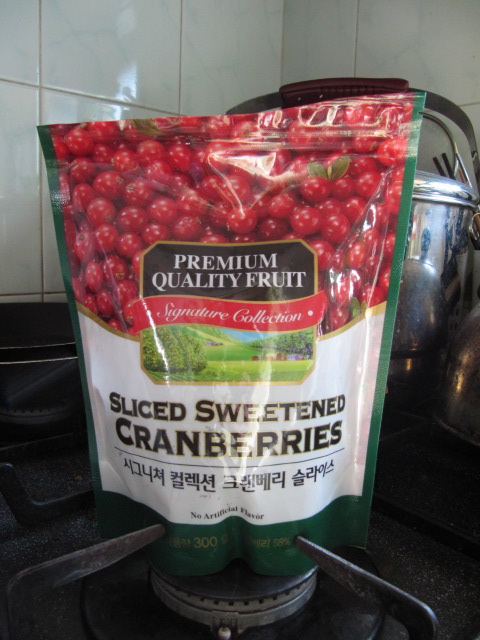
Another one I've tried is adding dried cranberries I picked up at E-mart. Actually, since they are dried, they don't really give any flavor, but I just like cranberries.


Another discovery we've made is freezing it to make frozen yogurt. It only takes about 1/2 an hour to freeze solid so it can be prepared not long before eating. The purple color is the 복분자.

Now, there's something else that can be made in a yogurt maker, though people may not be as familiar with this one as they are with yogurt. Have you heard of natto? It's a fermented bean product from Japan. It's usually made with soybeans but we've been experimenting with various types of beans with mixed results (the worst being when my boyfriend used dried peas claiming they were beans because the Korean word for pea is 완두콩 wandukong, kong meaning bean. They are in fact not beans, and they in fact make really repulsive natto in case you were planning on trying). Many westerners would be turned off by the strong smell and strange stringy consistency of natto, but it has become a bit of an obsession for me. I've always enjoyed beans and this makes an excellent breakfast food. Alas, this one is even more expensive than the yogurt, about 5,000 won for 6 or worse, 2,500 for 2. You can get 3 for a dollar in Japan. Which makes me look forward to my upcoming trip to Japan in December :-)


So, now that I've peaked your interest in making natto you'll find that it is a little more involved than the yogurt. First you have to hydrate the beans. usually we soak them for a while then put them in our high pressure rice cooker for a few more hours.


Next is adding previously made natto to start the culture growing.


Next, you just put it in the yogurt maker for at least 24 hours (though we've been doing 36-48 hours lately) Then it's ready to eat! Make sure it's nice and stringy!


And this isn't natto or yogurt and has nothing to do with . It's my homemade guacamole. I found 2 avocados for 2,500 won on the clearance shelf at E-mart and had to buy them since it's nearly impossible to get reasonably priced avocados in this country. So, I just mashed it up with onion, tomato and a splash of lime juice and had this amazing concoction.

Tuesday, November 9, 2010

Cambridge Day at Sookmyung Women's Universty


A few weeks back I discovered a facebook add for a free seminar day hosted by the book publisher Cambridge Press. I'd never been to anything like this in Korea, or anything like this that was ESL related for that matter, so I signed up on their website not really sure if I was going to go or not.


I was a bit confounded by their confirmation which stated the times for the event as being 9:00am - 4:30 pm to host only 4 speakers. With no times stated for each of the speakers, there was no way I was going to wake up at 7:00 am to get there by 9 on a Sat. morning (after having stayed up drinking with a friend who is leaving Korea soon until 3 am). In fact, it was more or less a miracle that I left my house around 12:30 to get over there. Of course, the second problem was that the only directions provided by their email (their website was even less helpful) was that it was in Sookmyung Women's University Music Hall, 6F. Luckily, Sookdae is one of the few colleges I am aware of the location of. After looking on Google I found one of the buildings labeled 음악대학, which, of course I could read as being College of Music, but there was no way of telling whether the "music hall" resided within this building or not. If I hadn't been able to read hangul, it might have been a problem, and assuming that people attending the seminar were English teachers, I'd say it's a fair assumption that there are some that can't read hangul, or even if they can, can't understand what it says. Fortunately, the campus, upon arrival, had some English signage and I found the way to the Music Department. As I got close, signs for the event were posted around with some arrows pointing in the right direction, but I was quite disappointed in the lack of information about the times/ directions to the event.


My agitation subsided a bit when, upon signing in to the event, I was handed a free bag, a free t-shirt and then asked if it was ok if they gave me a ham sandwich (from subway!!) because it was the only kind they had left. It was just after 1pm when I had arrived and the next lecture was to start at 1:30. I ate a few bites of the sandwich, but actually I was quite full so I stored it for later and headed up to the lecture hall.


While we waited for the speaker, Charles Browne to begin his lecture on Comprehending Authentic Video: The Importance of High Frequency Vocabulary, the MC advertised some of the free gifts to be given away later in the day. Some backpacks, gift certificates and a grand prize of a HP netbook were to be giving out throughout the day.


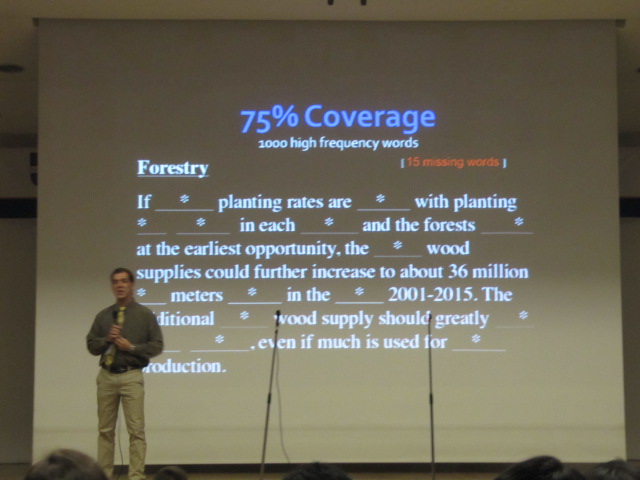
Finally it was time for the presentation. I didn't really know what to expect with the title of the presentation, it wasn't one of the lectures I had been more keen on seeing, but I'm glad I did. Basically, to sum up his presentation, he described the need for teaching "high frequency words" while teaching English. As a professor in Japan, he finds Japanese textbooks emphasizing all the wrong words. He explained that, while students generally had a good grasp of the first 1,000 most commonly used words in the English language, textbooks tended to skip over the next level, say the next 2-5,000 most commonly used words and go straight to very high level vocabulary to "prepare students" for college entrance exams. In the above picture, he is demonstrating that 75% comprehension level of the words, this is essentially what a text might look like to an English learner. Give it a read yourself and see if you can get any of the words from the blanks. Pretty much impossible, huh? Now, go tell yourself  to use "context clues" to figure out the words in the blanks like I'm sure most of you English teachers do all the time. And you wonder why your students can never figure out the meaning using the "context".

I really liked this guy because he really made me think again about the way I teach vocabulary. He also had some recommended websites that can pick out high frequency words and tell the teacher exactly which words the students will have difficulty with (and therefore make it easier to create vocabulary lists and the like) and also help you decipher whether or not something may be more difficult than you realize for your students.
After this presentation, there was another seminar which sounded to me like how to use Cambridge Press textbooks in the classroom, so rather than watching useless information, I decided to call it quits for the day and head to my Korean class, which was conveniently only a 10 minute walk away. I took a quick walk through the book store but as I'm not in the position of buying books at my school it wasn't really worth my time. Actually, we have some of the books that they had on display at my school anyway.

Anyway, this seems like an annual event here, so if you happen to see an ad for it next year, check it out. Free stuff and at least one good lecturer (although I'm sure they were all worth watching).

Sunday, November 7, 2010

Get Well Adi and First Place in the League


Last weekend we found ourselves at yet another FC Seoul game. This one was dedicated to one of their foreign players named Adi who had been injured a few weeks weeks before and is still unable to play. We first saw him out front of the stadium for some photo ops with children. Then when we entered the stadium, we received a rather strange face mask that was supposed to look like Adi.


Then Adi was on the field to say some words of thanks while everyone cheered and waved his number.


The rest of the game was good, ending with a win for FC Seoul, as usual. I've been to quite a few games now and I've only seen wins. 


We had to go to the FC Seoul game today too, seeing as how it was the last regular season game of the year. 


It was an exciting game against Daejeon and they broke the tie in the final minutes of the game to win the game. 


They end their season as #1 in the league. This game was crucial because if they had lost, Jeju United, #2 in the league would have pulled ahead and stolen their position. Now the next game will be Dec. 5th for the last game in the playoffs where another team will battle FC Seoul.

Sock Man


My friend took us to his favorite place to buy socks on Friday night. He's just a random vendor on the street in Dongdaemun, but the socks are crazy cheap. 10 pairs for 6,000 won.


My friend picked up lots of socks to bring home to England with him in a few weeks, and we got a few for ourselves too. Our friend tried on one pair when we got back to my place and realized that there were actually feet on his socks. We all agreed these were the coolest socks imaginable. If you find this vendor in Dongdaemun, be sure to buy some foot socks. 

Saturday, November 6, 2010

Jeju Guide: 성산 일출봉 Seongsan Ilchulbong or Sunrise Peak


Seongsan Ilchulbong is one of the most famous landmarks in Jeju. It formed as an under the sea volcanic eruption 100,000 years ago, but what you see today is a 600 stair climb to the top of a ridge overlooking a grass covered crater. Slow erosion from this ancient vent has actually connected it with the mainland of Jeju which is wide enough for a small, tourist centered village to arise along with a strip connecting the mainland conveniently just wide enough to fit a road.


Climbing to the top can be a bit arduous, especially if you happen to have climbed Hallasan in the days before climbing Ilchulbong. But, nice views await you along the way and from the top. Many come here to view the sunrise (no wonder, considering it's name) and we had planned to do the same, but were unable to get up in time. We weren't too bothered by this though, when we realized it was the first cloudy day we'd had since arriving in Jeju.


The surrounding area of Ilchulbong is quite nice to take a walk around as well. We saw some horses grazing in the fields and we wandered down some stairs to see this beach.

As one of the most famous sites in Jeju, you'll find yourself among millions of tourists climbing up along with you. As this is close to the ferry for Udo (cow island), a favorite among tourists as well, you may find yourself in the area anyway. It seems most tours consider this a must do, so when you visit Jeju, you may also feel the same.

Tuesday, November 2, 2010

Couchsurfers, grilled meat and donuts

In our house with the Filipina couchsurfers

Last week was a busy week in our home. Monday and Tuesday we hosted two Filipina women who were visiting Korea for the week. Then Wednesday night, the same French couchsurfers who came in September came back until Sunday morning before they flew out of Korea.


Since Saturday was their last day in Seoul, they wanted to eat some galbi as their last real meal before leaving. So, we met my friend and her boyfriend and walked around Sincheon until we found a decent looking place. Note to self, most galbi restaurants aren't open in the afternoon. Finally, we found a place and wound up ordering a 40,000 plate of various cuts of meat, including samgyupsal, galbi along with other unidentified tasty things and an overwhelming amount of mushrooms. Split between 5 people, the price was quite reasonable!

Meat and Mushrooms 


Feasting
After our feast of grilled pork, we got on the discussion of dessert. And how in France (I was the only one at the table who wasn't either French or had not lived in France) people always eat dessert after meals. We toyed with the idea of going to that pie place in Itaewon, but eventually we settled with going to Krispy Kream since they had never seen one before, and because Itaewon is not exactly close from Sinchon.

Ben, Gaelle and cheesecake donuts
While I'm not a fan of donuts in general, and specifically those from Krispy Kreme (me + that much sugar = stomachache) , our guests seemed quite happy with their donuts.

But the part we got the most excited for was the "Doughnut Theater" in the back. When the donuts started flowing, we all stood around watching for quite some time examining the process. We got sad when two donuts got stuck together and got put in the trash. And we pondered how the donut shape was formed. Was it one long piece of dough stuck together at the ends? Was it one round piece of dough with the middle carved out? But, they had a mirror in place so that you could only see the frying and glazing part of the process. Boo.

Anyway, from there is when the Halloween adventures of the last post began, so if you're interested, check out my last post.